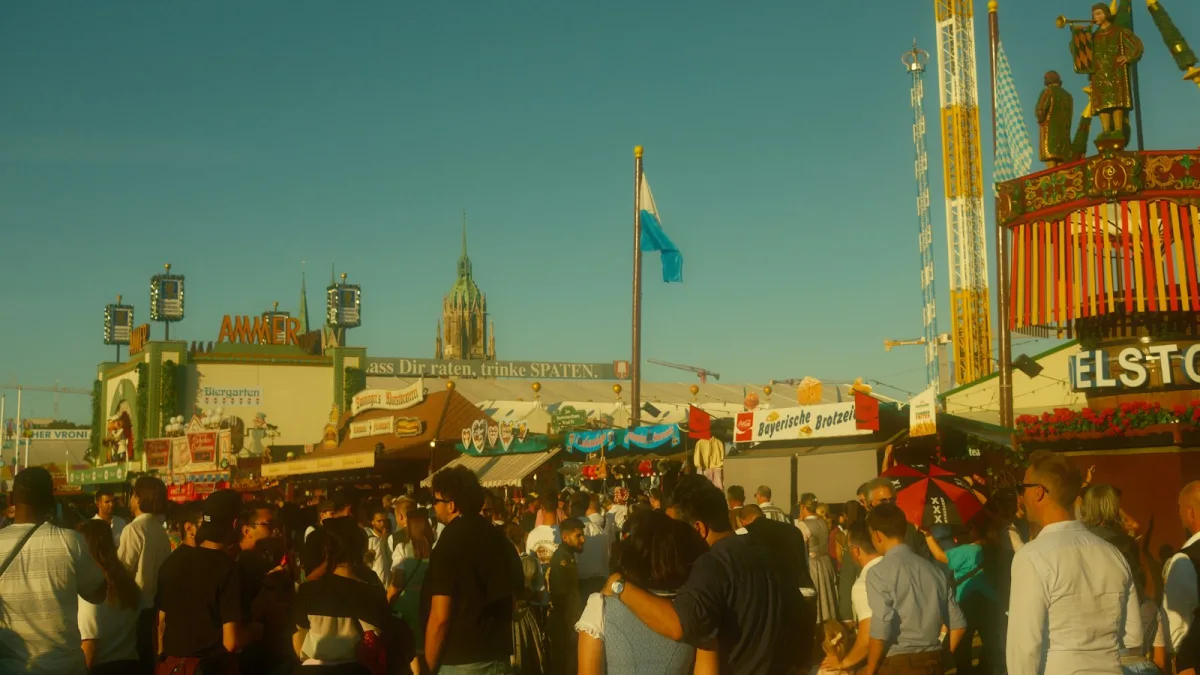
Most Americans have been to an Oktoberfest. A tent in a parking lot, a polka band, a few German beers on tap and someone in a novelty felt hat. The original in Munich is a different thing entirely: a two-and-a-half-week city within the city, run by strict rules, attended by millions, and, confusingly for newcomers, mostly held in September.
If you're moving to Munich, or anywhere in southern Germany, the Wiesn, as locals call it, stops being a tourist attraction and becomes part of your calendar. Colleagues go together, offices empty on a sunny afternoon, and turning up in the right clothes matters more than you'd think. This guide covers what makes the Munich original different from the American version, and how to enjoy it like a resident rather than a visitor.
Oktoberfest in Munich vs. the US at a Glance
| Munich's Oktoberfest | A typical US Oktoberfest | |
|---|---|---|
| When | Saturday after Sept 15 to the first Sunday in October | Usually a weekend or two in September or October |
| Where | The Theresienwiese ("the Wiesn") in central Munich | Town squares, fairgrounds, breweries, parking lots |
| Beer | Only from Munich's six traditional breweries | Whatever the organisers choose, often local craft beer |
| Entry | Free to the grounds and the tents | Often a ticket or entry fee |
| Size | Millions of visitors every year | Hundreds to tens of thousands |
| Serving | One-litre glasses (a Maß) | Usually pints or plastic cups |
| Dress | Dirndl and Lederhosen worn by locals | Mostly costume, if at all |
Why Oktoberfest Starts in September
The name is misleading. The city of Munich sets the dates by a fixed rule: the festival runs from the Saturday after September 15th until the first Sunday in October, and if that Sunday falls on October 1st or 2nd, it's extended to October 3rd, the German national holiday. That makes it roughly sixteen to eighteen days, most of them in September.
The reason is the weather. The festival grew out of the celebrations for the wedding of Crown Prince Ludwig and Princess Therese in October 1810, when the people of Munich were invited to the fields outside the city, which were named Theresienwiese after the bride. Horse races held there turned into an annual event, and over time the festival moved forward into September to catch the warmer, longer evenings. The October finish is what's left of the original timing.
The Beer Rule: Only Munich Will Do
Here's the sharpest difference from any American Oktoberfest. In Munich, only beer from the city's six traditional breweries is served: Augustiner, Hacker-Pschorr, Hofbräu, Löwenbräu, Paulaner and Spaten. No imports, no craft guest taps, no beer from the rest of Bavaria.
"Oktoberfestbier" is even protected under EU law. Since 2022 it has been a registered Protected Geographical Indication, which means beer sold under that name has to be brewed within the city of Munich to a set specification. It's served in a one-litre glass, the Maß, and it's noticeably stronger than a typical American lager, which is worth remembering before the second one.
How the Wiesn Actually Works
The scale is hard to picture until you're there. Several million people visit each year, and recent years have topped seven million. The grounds hold large beer tents, each run by its own host family with its own brewery, music and character, alongside smaller tents, food stalls and fairground rides.
A few things surprise first-timers:
- It's free. There's no entry fee for the grounds or the tents. You pay for what you eat and drink. The exception is the Oide Wiesn, a historic section with old-fashioned rides and music, which charges a small entry fee.
- Seats are the real currency. Tables in the big tents are reserved months ahead, usually by companies and groups booking directly with each tent. Unreserved areas exist, but on evenings and weekends they fill early, and tents can close their doors when they're full.
- It ends early. The large tents stop serving at 10:30pm and the grounds close at 11:30pm. This is not an all-night party.
- It opens with a ceremony. On the first Saturday at noon, the Mayor of Munich taps the first barrel in the Schottenhamel tent with the cry "O'zapft is!" ("It's tapped!"), and only then does the beer start flowing across the grounds.
Tracht: Dirndl and Lederhosen
In Munich, the traditional clothing, Tracht, isn't a costume. Many locals wear it to the Wiesn as a matter of course: a Dirndl for women, Lederhosen for men, often with a checked shirt. You'll see it on the U-Bahn, in offices on the days colleagues go together, and in every tent.
If you're living there, it's worth buying a proper set rather than a cheap costume version. Tracht shops in Munich range from affordable to very expensive, and second-hand shops do good business in the weeks before the festival. You don't have to wear it, plenty of people go in normal clothes, but showing up in decent Tracht is a small, appreciated way of joining in.
How American Oktoberfests Differ
American Oktoberfests have their own long tradition, rooted in the country's large German-American heritage. Towns with strong German roots, such as Cincinnati, Frankenmuth in Michigan, New Ulm in Minnesota, Fredericksburg in Texas and Leavenworth in Washington, host some of the best-known ones.
They tend to differ from Munich in predictable ways. They're shorter, usually a weekend or two. They often charge for entry and pour a wide range of beer, frequently showcasing local breweries. They're more of a street fair or family festival than a city-wide institution. None of that makes them less fun, but if your picture of Oktoberfest comes from the American version, Munich's sheer size and its strict rules will take some getting used to.
Going to the Wiesn as a Munich Local
Once you live in Munich, the Wiesn changes character. It becomes a social and even a work event: teams book tables together, companies host clients, and a weekday afternoon in a tent with colleagues is a normal part of the season. For a newcomer, saying yes to those invitations is one of the fastest ways to build friendships in a city where they can take time to form, as our guide to making friends in Germany explains.
The best way to enjoy it as a resident is to avoid the tourist rhythm. Go on a weekday, ideally at lunchtime or early afternoon, when tents are calmer and seats are easier to find. Skip the opening weekend and the evenings, which belong to the crowds. And try some of the other local festivals too: Munich's own spring festival on the same grounds, and Stuttgart's Cannstatter Volksfest, which runs at about the same time of year, are both much more relaxed.
Practical Tips for Your First Wiesn
- Bring only a small bag. Bags are limited to 3 litres, roughly 20 × 15 × 10 cm. Anything bigger has to go into paid storage at the entrances, and security checks bags on the way in.
- Get in early, or get a reservation. Without a reserved table, arrive by late morning on a weekday, or join a group that has one.
- Pace yourself. A Maß is a litre of stronger-than-usual beer. Eat something, a roast chicken or a pretzel, and drink water in between.
- Know when it ends. Last beer orders in the big tents are around 10:30pm, and the grounds close at 11:30pm.
- Check the crowds before you go. The official Oktoberfest site runs a crowd barometer showing the quieter days and times. Strollers are not allowed on Saturdays and public holidays, or after 6pm on other days, so plan family visits for weekday daytimes.
Frequently Asked Questions
Why is Oktoberfest in September? The festival grew out of a royal wedding celebration in October 1810 and was later moved forward to take advantage of warmer September weather. Today Munich sets the dates by a fixed rule: from the Saturday after September 15th to the first Sunday in October, extended to October 3rd in some years.
Is it free to go to Oktoberfest in Munich? Yes. Entry to the grounds and the beer tents is free, and you pay only for food, drinks and rides. The Oide Wiesn, a historic section with traditional rides and music, charges a small entry fee.
What beer is served at Oktoberfest? Only beer from Munich's six traditional breweries: Augustiner, Hacker-Pschorr, Hofbräu, Löwenbräu, Paulaner and Spaten. "Oktoberfestbier" is protected under EU law and must be brewed within the city of Munich. It's served in one-litre glasses called a Maß.
Do I need to wear a Dirndl or Lederhosen to Oktoberfest? No, but many locals do, and it's seen as traditional clothing rather than a costume. If you live in Munich, a proper set is a worthwhile buy. Plenty of visitors go in everyday clothes.
How is Munich's Oktoberfest different from American Oktoberfests? Munich's is far bigger, with millions of visitors over more than two weeks, it's free to enter, and it serves only beer from six Munich breweries in one-litre glasses. American Oktoberfests are usually shorter, often ticketed, and pour a wider range of beers, frequently from local breweries.
Oktoberfest in Munich is a world apart from the parking-lot version back home: older, bigger, stricter about its beer and, for residents, as much a social calendar fixture as a party. Go on a weekday, get a seat, wear the Tracht if you have it, and say yes when your colleagues invite you. For more on life in the city, our Munich city guide covers the rest, and our guide to Christmas in Europe covers the next big season.
Official sources:
- muenchen.de, Oktoberfest, the City of Munich on dates, history, tents and opening hours
- Oktoberfest.de, the six Munich breweries, the official site on which beer is served
- Oktoberfest.de, security, the official rules on bag sizes
- European Commission, geographical indications, the EU scheme that protects Oktoberfestbier