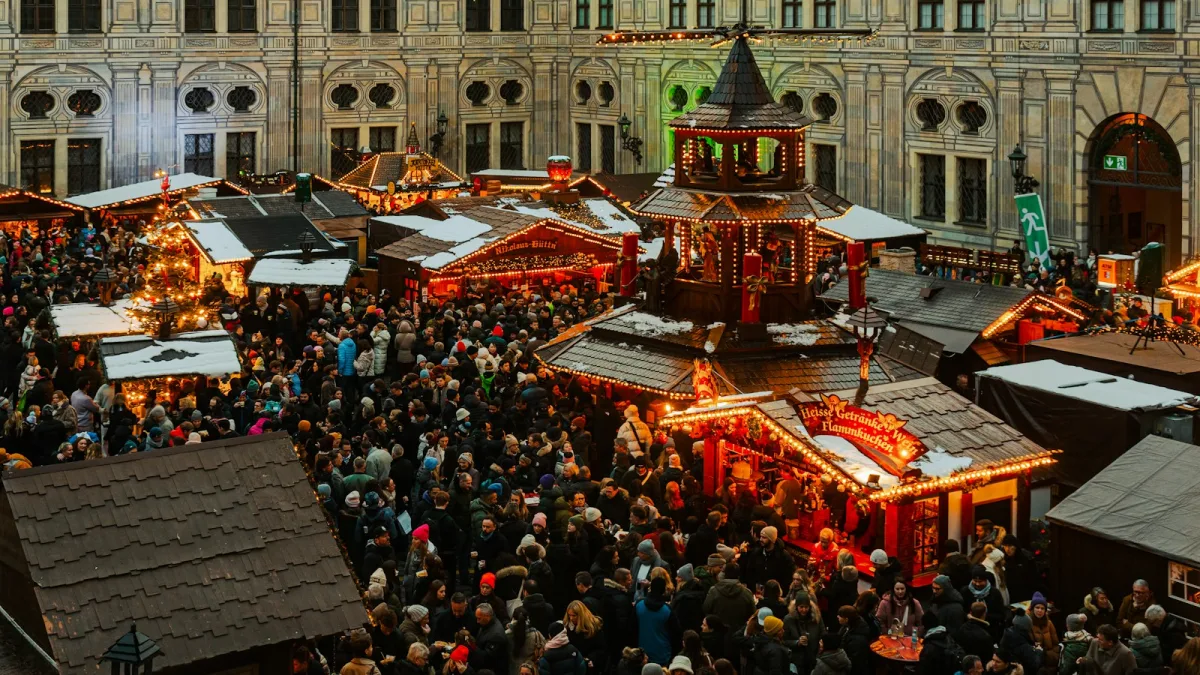
Your first Christmas in Europe will feel familiar and strange at the same time. The trees, the lights and the carols are all there, but the rhythm is different. There's no Black Friday starting gun and no frantic sprint to December 25th. Instead the season builds slowly through Advent, the big night in much of the continent is Christmas Eve, the cities fill with open-air markets, and then, for a week or two, a lot of the working world simply stops.
For an American, that slowdown is usually the biggest surprise and, once you're used to it, the best part. This guide covers what's actually different, how it varies from country to country, and how to make your first European Christmas a good one rather than a lonely one.
Christmas in Europe vs. the USA at a Glance
| United States | Europe | |
|---|---|---|
| The big day | December 25th | Varies: Dec 24th in Germany, Austria, Poland and Scandinavia; Dec 25th in the UK and Ireland |
| Season | Thanksgiving to Christmas Day | Four weeks of Advent, often through Epiphany (Jan 6th) |
| Gift-bringer | Santa Claus | Santa, St Nicholas, the Christkind, Sinterklaas or the Three Kings, depending on where you are |
| Social centre | Homes, malls, office parties | Open-air Christmas markets |
| Decorations | Big, bright, often inflatable | Real trees, wooden crafts, candles, warm street lighting |
| Time off | Often just Dec 25th and Jan 1st | Two public holidays in many countries, plus leave many people stack into two weeks off |
Christmas Eve or Christmas Day?
In the US, Christmas morning is the centrepiece: presents under the tree, a big meal, the day at home.
Across much of Central, Northern and Eastern Europe, the main event happens the night before. In Germany and Austria it's Heiligabend, in Poland Wigilia, in Sweden Julafton. Shops and offices close early on the 24th, families gather in the late afternoon, and the evening brings the meal and the presents. In Germany, shops can stay open only until 2pm on Christmas Eve, so the whole country quietly winds down by early afternoon.
That isn't universal. The UK and Ireland keep December 25th as the main day, much as the US does. The Netherlands and Belgium give their big children's presents on Sinterklaas (the evening of December 5th in the Netherlands, the morning of the 6th in Belgium) and keep Christmas itself low-key. In Spain, children traditionally get their gifts on January 6th from the Three Kings (los Reyes Magos). So "European Christmas" is really a dozen national Christmases, and part of the fun is finding out which one you've landed in.
Advent, St Nicholas and the Other Gift-Bringers
Where the American season is one long countdown from Black Friday, the European one runs through a series of smaller moments.
Advent. For the four Sundays before Christmas, many households light one more candle on an Advent wreath (Adventskranz in German), and Advent calendars, often reusable wooden or fabric ones filled by parents, count down the days.
St Nicholas Day, December 6th. In Germany, Austria and nearby, children put their boots out on the evening of the 5th and find them filled with nuts, oranges and chocolate in the morning.
Krampus. In the Alpine regions, St Nicholas has a darker companion, the horned Krampus, who keeps children in line. Krampus parades are a genuine spectacle in parts of Austria and Bavaria.
The Christkind. In much of southern Germany and Austria, Christmas Eve presents are brought not by Santa but by the Christkind, a childlike angel figure. Nuremberg's famous market is even opened by one.
Epiphany, January 6th. The season formally ends with Three Kings' Day, a public holiday in some countries and regions, including Austria, Italy, Spain and parts of Germany.
Christmas Markets: Europe's Winter Living Room
If one thing defines the European Christmas for newcomers, it's the markets. From late November until just before Christmas, old town squares in cities like Nuremberg, Vienna, Munich, Strasbourg, Cologne and Wrocław fill with wooden huts, lights and the smell of roasting chestnuts.
They're less about shopping than about meeting people. After work, colleagues and friends stand around high tables with a mug of Glühwein (mulled wine) or Kinderpunsch, eat a sausage or some gingerbread (Lebkuchen), and talk. For a newcomer, that makes them one of the easiest social settings you'll find all year: inviting a colleague for a Glühwein after work is a perfectly normal thing to do, and a good way to turn office acquaintances into friends.
One practical note: many markets charge a deposit on the mug. Return it and you get the money back, or keep it as a souvenir.
The Food: Regional Rather Than One Big Roast
The American Christmas table often looks a lot like Thanksgiving: turkey or ham, mashed potatoes, pies. In Europe, the menu depends heavily on where you are:
- Germany and Austria: Christmas Eve is often surprisingly simple, potato salad with sausages in many families, with the roast goose, red cabbage and dumplings saved for Christmas Day. Stollen and a whole repertoire of Christmas biscuits fill the gaps.
- Poland: the Wigilia supper is meatless, traditionally twelve dishes, with carp, beetroot soup with small dumplings, and pierogi.
- Italy: Christmas Eve is typically a seafood dinner, followed in the days after by panettone or pandoro. (The "Feast of the Seven Fishes" name is an Italian-American tradition that grew out of it.)
- France: the Réveillon dinner on Christmas Eve brings oysters, foie gras and smoked salmon, finished with a bûche de Noël.
- UK and Ireland: the closest to the American table, with roast turkey, plus Christmas pudding and mince pies.
Decorations and Atmosphere
European Christmas decoration tends to be quieter. Real fir trees bought a week or two before Christmas, wooden ornaments, candles, evergreen branches and warm, golden street lighting that works with the old buildings rather than over them. The American style, with whole-street light shows and inflatables in the yard, is bigger and brighter. Neither is better, but the difference is one of the first things expats notice walking through a European city in December.
The Real Difference: The Winter Slowdown
The biggest change for a US professional isn't the food or the markets. It's work.
The US has no legally required paid vacation, and many employers give little more than Christmas Day and New Year's Day off. In the EU, every worker is entitled by law to at least four weeks of paid annual leave, and many professional jobs offer more. Germany, Austria, the UK, Ireland and others also have two Christmas public holidays, December 25th and 26th.
Put those together and a lot of Europeans take one or two weeks off between Christmas and New Year, often without touching much of their leave. Offices go quiet, inboxes slow down, and hiring and admin processes pause until the second week of January. If you're mid job search or waiting on paperwork in December, expect things to stall, and plan for it. Our paycheck comparison has more on how European leave compares with the US, and our guide to German work culture covers how seriously that time off is protected.
Tips for Your First European Christmas
- Shop early. In many countries shops close early on December 24th and stay closed on the 25th and 26th. Stock up on groceries a few days ahead, because the last afternoon before Christmas is a scramble.
- Say yes to the market invitations. A Glühwein with colleagues is the easiest way to make work friends in your first winter.
- Make a plan for the holidays themselves. If you're not travelling home, the quiet days can be the hardest. Arrange something with other expats, join a local event, or plan a trip, because holidays and milestones are when homesickness hits hardest, as our guide to homesickness explains.
- Use the time off to travel. Living in Europe puts other countries' Christmases a short train ride away. Vienna, Strasbourg or a snowy Alpine town make an easy first-winter trip.
- Pick up a few local traditions. Learn the local greeting, try the regional dishes, put your boots out on December 5th. Joining in is how a foreign Christmas starts to feel like yours.
Frequently Asked Questions
Do Europeans celebrate Christmas on December 24th or 25th? It depends on the country. In Germany, Austria, Poland and Scandinavia the main celebration, with the family meal and presents, is on the evening of December 24th. The UK and Ireland celebrate mainly on December 25th, as in the US, while Dutch children get their big presents on Sinterklaas (December 5th) and Spanish children traditionally on January 6th.
Is December 26th a holiday in Europe? In many countries, yes. Germany, Austria, the UK, Ireland, Poland and others treat December 26th as a public holiday, known as Boxing Day in the UK and St Stephen's Day in Ireland. France and most of Spain do not (Catalonia is an exception), so it depends where you live.
When do Christmas markets open in Europe? Most open in late November, around the start of Advent, and run until just before Christmas, often ending on December 23rd. A few stay open until New Year. Dates vary by city, so check the local market's website.
Do people in Europe get more time off at Christmas than in the US? Generally yes. The US has no legally required paid vacation, while EU law guarantees at least four weeks of paid leave a year, and many countries add December 25th and 26th as public holidays. Many Europeans take one or two weeks off between Christmas and New Year.
Are shops open on Christmas Eve in Europe? Usually only until early afternoon. In Germany, shops may open until 2pm at the latest on December 24th, and most supermarkets close earlier than that. On December 25th and 26th nearly everything is closed in much of Europe, so shop a few days ahead.
A European Christmas trades the American rush for something slower: Advent candles, a crowded market on a cold evening, a long dinner on Christmas Eve and a week when the working world really does switch off. Plan your shopping, plan your company for the quiet days, and say yes to the Glühwein. For more on settling in, our first 30 days guide covers the practical side.
Official sources:
- Your Europe, EU rules on minimum paid annual leave
- U.S. Department of Labor, on the absence of a federal paid vacation requirement
- Ladenschlussgesetz §3, German federal law closing shops from 2pm on December 24th