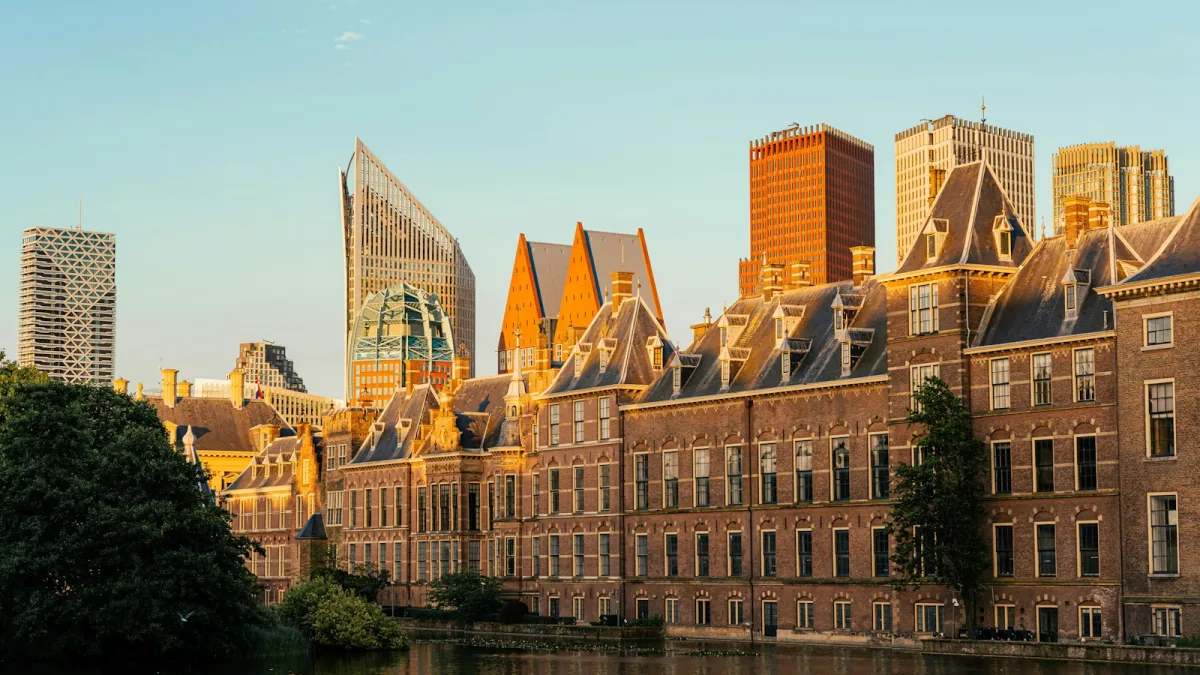
The Hague is the Netherlands at its most international and its most grown-up. It's the seat of the Dutch government, the home of the royal family, and the world's self-styled city of peace and justice, with the International Court of Justice, the International Criminal Court and a dense cluster of embassies, courts and global organisations. If Amsterdam is startups and nightlife and Rotterdam is the port, The Hague is law, diplomacy and policy, with eleven kilometres of North Sea coastline attached.
For a certain professional, it's the best fit in the country. The job market leans on international law, government, NGOs, cybersecurity and energy, the workplaces in those sectors run in English, and the city is calmer, greener and more spacious than Amsterdam, with the beach at Scheveningen a tram ride away. It is also, for the Netherlands, notably family-friendly and well supplied with international schools.
This guide is about The Hague the city, its districts, the housing search, what you'll earn and keep. For the Netherlands-wide machinery, the visa, the 30% ruling, the freelance route, we've written those separately and linked them where they matter.
Key Facts at a Glance
| Detail | Info |
|---|---|
| Population | ~550,000, the Netherlands' third-largest city |
| Status | Seat of government and royal residence (Amsterdam is the capital) |
| Vibe | International, diplomatic, refined, family-friendly, coastal |
| Main industries | International law, diplomacy, government, cybersecurity, energy |
| Main work visa | Highly Skilled Migrant permit, via an IND-recognised sponsor |
| Tax perk | The 30% ruling, tapering to 27% from 2027 |
| English | Widely spoken, international sectors run in English |
| The draw | Global institutions, beaches, space, strong international schools |
| Best for | Lawyers, policy and NGO staff, cybersecurity and energy professionals |
Why The Hague, and Why Not
The Hague's job market is unlike anywhere else in the Netherlands. As the seat of government and the base for the International Court of Justice, the International Criminal Court, Europol, Eurojust and the OPCW, it supports a steady demand for people in international law, human rights, policy, compliance and multilateral project work, backed by more than 160 international organisations and diplomatic missions. Alongside that, the city has become the country's cybersecurity hub, the so-called Security Delta, and a growing centre for offshore wind and energy. If your field is any of those, the work is concentrated here.
The lifestyle case is strong. The Hague is more spacious and calmer than Amsterdam, rents are lower, and it has something no other big Dutch city does: real beaches, at Scheveningen and Kijkduin, within the city limits. It's compact, easy to cycle, and well set up for international families, with a cluster of IB, British and American schools. English works across international workplaces and daily life.
The downsides are modest. It's more buttoned-up and corporate than Amsterdam, the Dutch housing market is competitive everywhere, and if your field isn't one of the city's specialisms the job market is thinner than the capital's. For how it compares with the other Dutch cities, our Amsterdam and Rotterdam guides sit alongside this one, as does our guide to the Netherlands for professionals.
The Districts: Where to Actually Live
- Statenkwartier: elegant and leafy, near the beach and the international institutions, a favourite with diplomats and international families.
- Bezuidenhout: modern and convenient, right by Den Haag Centraal station, popular with commuters to Amsterdam or Rotterdam and younger professionals.
- Archipelbuurt and Willemspark: stately historic townhouses and quiet squares, walking distance to the centre, favoured by senior legal and embassy staff.
- Scheveningen: the coastal resort district, beachfront living for people who want the sea on their doorstep.
- Benoordenhout: green, calm and affluent, with larger homes and good schools, a family favourite next to Clingendael park.
As everywhere, the smartest and most central districts cost the most. The trade is the usual one: minutes to work against euros per month.
The Housing Reality
Housing is the hardest part of a Hague move, as it is across the Netherlands. Rents are lower than Amsterdam's, but demand is high and good listings go fast, so preparation matters.
A few things to know:
- Register to get a BSN. If you're staying longer than four months, you register with the municipality to get your BSN, the citizen number you need for a job, a bank account and health insurance. Confirm your rental allows registration before you sign, because some don't.
- Budget realistically. Housing is the single biggest expense, and the diplomatic and international districts carry a premium. Work out the full monthly picture before committing.
- Land first, then search. A furnished short-term place for the first couple of months lets you view long-term homes in person, which is the norm here.
Getting In: Visa Routes
For most non-EU professionals, the route in is the Highly Skilled Migrant (kennismigrant) permit. Your employer has to be an IND-recognised sponsor and files the application, which makes it one of the faster work-permit processes in Europe once you have the offer. The condition is a gross salary above the IND's annual threshold. Highly qualified graduates can also use the EU Blue Card, and staff moving within a company can come on an intra-corporate transfer.
Because the permit depends on a sponsoring employer, the first step is landing the job. Our Highly Skilled Migrant Visa Netherlands FAQ covers the sponsor rules, the 2026 salary thresholds and family members, and the freelancing and ZZP guide covers the self-employed route.
What You'll Earn and Keep
The Hague pays well, with the strongest salaries in international law, finance, cybersecurity and energy, though still below equivalent US packages in raw terms. The 30% ruling narrows that gap.
The ruling lets a qualifying employer pay up to 30% of your gross salary as a tax-free allowance for up to five years. The current detail, which a lot of older articles get wrong: the rate is 30% through 2026, then steps down to 27% from 2027 for new claimants, capped at a salary of €262,000. Our Netherlands 30% ruling 2026 guide has the full picture. Dutch health insurance is mandatory, averaging around €157 a month for the basic package in 2026, with children under 18 covered for free, on top of an annual deductible before most non-GP care.
Getting Around
You will not need a car in The Hague. The HTM tram and bus network links the districts, the government quarter and the coast, and the city is flat and very bikeable, with cycling the default for most trips. Two mainline stations, Den Haag Centraal and Hollands Spoor, put Rotterdam about 20 minutes away, Schiphol Airport around 30, and Amsterdam under an hour, with onward connections to Brussels and Paris.
The Catch
The Hague gives you a genuinely international career in law, policy, security or energy, a calm and spacious city, and beaches within the city limits, and asks you to accept a more corporate rhythm than Amsterdam and a job market built around its specialisms. The housing search is the part that tests people, so start it early. And while English carries you a long way, some Dutch helps for the long term, which our guide to Dutch culture covers.
If you're comparing the Dutch cities, Amsterdam is the tech-and-nightlife capital and Rotterdam the cheaper, roomier port city. Our guide to the top European cities for expats sets them against the rest of Europe.
Frequently Asked Questions
Is The Hague a good place for expats to live? Yes, especially for professionals in international law, government, NGOs, cybersecurity and energy. It has a uniquely international job market, English-friendly workplaces, a calm and spacious feel, beaches within the city, and strong international schools. The main trade-offs are a corporate rhythm and a job market built around its specialisms.
Is The Hague the capital of the Netherlands? No. Amsterdam is the official capital, but The Hague is the seat of the Dutch government, the home of parliament and the royal family, and the base for major international courts and organisations. In practice it's the country's political and diplomatic centre.
Is The Hague cheaper than Amsterdam? Yes, rents are lower than in Amsterdam and you generally get more space for the money, though the diplomatic and coastal districts carry a premium. Housing is still the biggest expense and the market is competitive.
Do I need to speak Dutch to work in The Hague? Not in the international sectors. IT, cybersecurity, international law, NGOs and multinational firms work in English, and daily life is easy in English too. Dutch is needed more in local government, healthcare and schools, and helps for long-term career growth.
What is The Hague known for? It's the international city of peace and justice, home to the International Court of Justice, the International Criminal Court, Europol and the OPCW, plus the Dutch government and royal family. It's also a growing cybersecurity and energy hub, with North Sea beaches at Scheveningen.
The Hague is the move for a professional whose field is law, policy, security or energy, and who wants an international, family-friendly city with the sea on its doorstep. Come with an in-demand skill, start the housing search early, and it's one of the most liveable relocations in Europe.
If you're weighing the Dutch options, our Amsterdam and Rotterdam guides cover the alternatives.
Official sources:
- IND, highly skilled migrant, permit conditions and the recognised-sponsor rule
- Rijksoverheid, Dutch basic health insurance and the 2026 premium
- City of The Hague, official municipal portal for registration and residents