
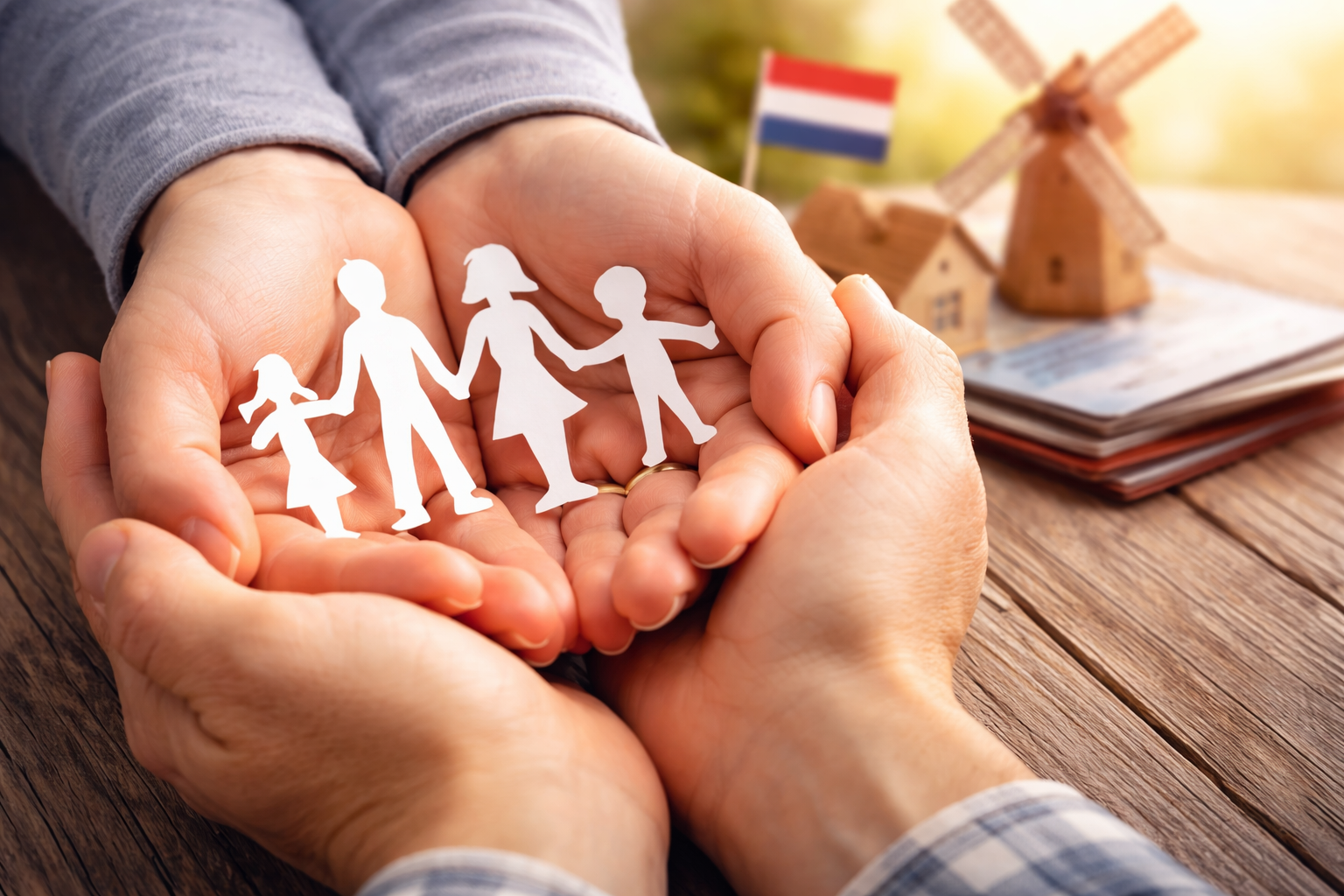
Relocating to the Netherlands for work or business is an exciting opportunity—but for most professionals, moving alone is not an option. Whether you’re planning to bring your spouse, partner, or children, understanding family reunification rights is essential to ensure a smooth transition.
The Netherlands is widely recognized for its structured and family-friendly immigration policies. If you are moving under a work permit such as the Highly Skilled Migrant (HSM), EU Blue Card, or the Dutch-American Friendship Treaty (DAFT), your spouse and family members can join you with relatively straightforward procedures—and, importantly, strong work rights.
This guide explains everything you need to know about spouse and family rights in the Netherlands, including visa-free entry options, residence permits, work authorization, and common mistakes to avoid.
Why the Netherlands is Family-Friendly for Expats?
The Dutch immigration system is designed to support international professionals and their families. Unlike many countries where spouses face strict employment limitations, the Netherlands offers:
- Full labor market access for spouses (after residence permit approval)
- No Dutch language requirement for initial family reunification
- Streamlined processes for visa-exempt nationals (like US citizens)
- The ability to apply from within the Netherlands in many cases
This makes the Netherlands one of the most attractive destinations in Europe for families relocating together.
Option A — Visa-Free Entry & In-Country Application (Best Option for US Citizens)
For US citizens and other visa-exempt nationals, this is typically the fastest and most efficient route to relocate with a spouse.
How It Works
- The spouse enters the Netherlands visa-free using a US passport
- They are allowed to stay for up to 90 days
- During this period, the sponsor (employee or employer) submits a family reunification residence permit application to the Immigration and Naturalisation Service (IND)
- Once approved, the spouse receives a residence card (VVR)
This process is fully legal under Dutch immigration law and is widely used by expats.
Why This Option Is the Best
This route is considered optimal for several reasons:
- No embassy delays — You avoid long waiting times for visa appointments
- Faster processing — Applications are handled directly by IND
- Immediate relocation — Families can travel together
- Simple documentation flow
- No pre-entry integration exam required
Most importantly, it allows families to stay together without unnecessary separation.
Key Conditions
To use this pathway, the following conditions must be met:
- The spouse must be visa-exempt (e.g., US citizen)
- A legally valid marriage or registered partnership must be recognized
- The sponsor must hold one of the following:
- Highly Skilled Migrant permit
- EU Blue Card
- Proof of:
- Sufficient income (already met through HSM/Blue Card salary thresholds)
- Health insurance coverage
- Application must be submitted within 90 days of arrival
Work Rights for the Spouse
Once the residence permit is issued, the spouse receives a residence card with the statement:
“Arbeid vrij toegestaan. TWV niet vereist.”
This means:
- Full access to the Dutch labor market
- No employer sponsorship required
- Freedom to work in any sector
- Ability to work full-time, part-time, or freelance
This is one of the strongest spouse work rights policies in Europe.
When This Option Can Fail
Although this route is straightforward, there are some common risks:
- Missing the 90-day application deadline
- Submitting incomplete or unrecognized marriage documents
- Sponsor losing their residence or employment status
Proper preparation is critical to avoid delays or rejections.
Option B — Family Reunification MVV (Type D Visa)
(Safer but Slower)
For individuals who are not visa-exempt or prefer a more secure process before traveling, the MVV (Machtiging tot Voorlopig Verblijf) route is available.
How It Works
- The spouse applies for an MVV (Type D visa) at a Dutch embassy or consulate
- After approval, they enter the Netherlands with the MVV
- A residence permit is issued after arrival
When This Option Makes Sense
This route is recommended when:
- The spouse is not visa-exempt
- Documentation is not fully prepared yet
- The family prefers pre-approved status before relocation
- The employer or IND advises using the MVV process
Downsides
While more secure, this route comes with trade-offs:
- Longer processing timelines
- Embassy appointment delays
- More administrative steps upfront
Can Spouses Enter Together with the Worker?
Yes—this is absolutely allowed.
- The main applicant (e.g., US citizen) can enter the Netherlands visa-free
- The spouse can enter at the same time (if also visa-exempt)
- The family reunification application can be submitted immediately after arrival
There is no mandatory separation period, which is a major advantage compared to other immigration systems.
Option US — DAFT Spouse & Family Rights
(For Entrepreneurs & Freelancers)
The Dutch-American Friendship Treaty (DAFT) offers a unique pathway for US citizens to live and work in the Netherlands as self-employed individuals. Naturally, family reunification is also supported under this scheme.
Who This Applies to
- Main applicant: US citizen with a DAFT residence permit
- Family member:
- Spouse (married), or
- Registered partner
- Spouse nationality: any (US, non-EU, etc.)
Legal Framework
Family members of DAFT permit holders are admitted under standard Dutch family reunification rules and receive independent work authorization after their residence permit is approved.
Entry to the Netherlands (Spouse)
If the spouse is visa-exempt:
- Can enter the Netherlands visa-free
If the spouse requires a visa:
- Must apply for an MVV from abroad
Important: Entering the Netherlands does NOT automatically grant work rights.
Application Process (Inside the Netherlands)
Step 1 — Submit Family Reunification Application
The application is filed with IND and can be:
- Submitted together with the DAFT application, or
- Submitted after the DAFT permit is approved
Required Documents Typically Include:
- Marriage certificate (apostilled and translated if necessary)
- Valid passports
- Proof of relationship
- Proof of income (DAFT business activity)
- Health insurance
- Proof of accommodation
Step 2 — Biometrics Appointment
The spouse must attend an in-person appointment with IND:
- Fingerprints collected
- Photograph taken
Step 3 — Residence Permit Issued
Once approved, the spouse receives a residence card with:
“Arbeid vrij toegestaan. TWV niet vereist.”
Work Rights for DAFT Spouses
After receiving the residence permit, the spouse can:
- Work immediately
- Be employed or self-employed
- Work full-time or part-time
- Work for any employer
- Operate a business independently
No sponsorship or salary thresholds apply.
Important Limitation
- The spouse cannot work while the application is still pending
This is a critical rule that many applicants misunderstand.
Processing Time
- Average processing time: 6–10 weeks
- Often issued alongside or shortly after the DAFT permit
- No fast-track option available
Validity & Renewal
- The spouse’s permit validity is aligned with the DAFT permit
- Renewable together
- Counts toward permanent residence eligibility
Common Mistakes to Avoid
Relocating with family involves multiple legal and administrative steps. Avoid these common errors:
1. Starting Work Too Early
Many spouses assume they can work immediately after arrival. This is incorrect. Work is only permitted after the residence permit is issued.
2. Missing Apostille & Translation Requirements
Marriage certificates must often be:
- Apostilled
- Translated into Dutch, English, German, or French
Failure to comply can delay or reject the application.
3. Confusing Visa-Free Entry with Work Authorization
Entering the Netherlands without a visa does NOT grant:
- Work rights
- Residence rights
A residence permit is still mandatory.
4. Missing Deadlines
The 90-day window for in-country applications is strict. Missing it may require restarting the process from abroad.
5. Weak Documentation for DAFT Income
DAFT applicants must demonstrate that their business is active and generating income. Poor documentation can affect both the main applicant and family permits.
Key Benefits of Moving to the Netherlands with Family
Choosing the Netherlands as your relocation destination offers several advantages:
- Strong legal protections for families
- Excellent work opportunities for spouses
- High quality of life and work-life balance
- Access to healthcare and education systems
- Pathway to permanent residence and citizenship
Final Thoughts
Relocating to the Netherlands with your family is not only possible—it is highly supported by Dutch immigration policies. Whether you are moving as a highly skilled worker or an entrepreneur under DAFT, your spouse can join you and gain full access to the labor market with minimal restrictions.
For US citizens in particular, the visa-free entry option combined with in-country application processing makes the Netherlands one of the most efficient and family-friendly relocation destinations in Europe.
However, success depends on careful planning, proper documentation, and understanding the rules—especially regarding work rights and application timelines.
If you’re planning your move, getting expert guidance can make the process significantly smoother and help you avoid costly mistakes.
Need help relocating to the Netherlands with your family?
Move2Europe supports you end-to-end—from job search and visa processing to relocation and settling in.