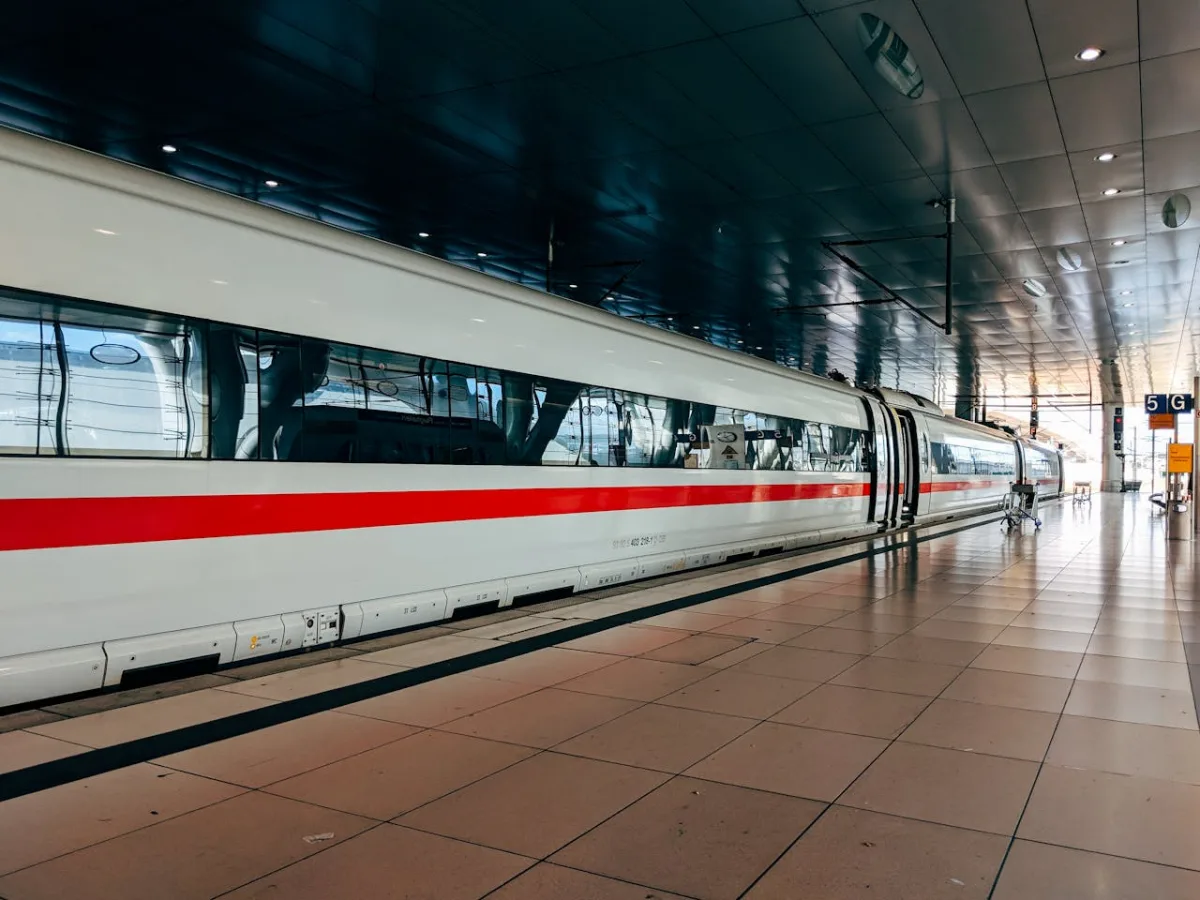
If you've just moved to Europe, you'll quickly discover that getting around the continent works differently than in the US. There's no TSA line, no $50 Uber to a distant airport, and no two-hour boarding process. Europe has a world-class high-speed rail network that connects major cities center-to-center, and for trips under 4–5 hours, trains often beat flying on every metric that matters.
But it's not always obvious which option is cheaper, faster, or more practical. Here's an honest comparison — including the hidden costs that airlines don't show you upfront.
Key Facts at a Glance
| Detail | Info |
|---|---|
| London–Paris (Eurostar) | 2h 16min, city center to city center |
| London–Brussels (Eurostar) | ~2 hours |
| London–Amsterdam (Eurostar) | ~4 hours |
| Paris–Brussels (Eurostar) | 1h 22min |
| Eurostar luggage | 2 bags + 1 hand luggage included |
| Budget airline hidden extras | EUR 55–85 on top of base fare |
| CO2 savings (train vs plane) | ~80–86% fewer emissions per passenger (EEA) |
| France flight ban | Domestic flights banned where train < 2.5 hours |
| Deutschlandticket | EUR 63/month — all regional/local transit in Germany |
| Best booking window (trains) | 3–4 months ahead for lowest fares |
Ticket Prices: Flights Look Cheaper (Until They Don't)
Budget airlines like Ryanair, EasyJet, Wizz Air, and Eurowings advertise fares that look unbeatable — EUR 20 one-way to Barcelona, EUR 35 to Rome. But that headline price rarely reflects what you actually pay.
Here's what gets added on:
- Checked baggage: EUR 20–40 per bag
- Seat selection: EUR 5–15
- Priority boarding: EUR 6–10
- Airport transfers: EUR 10–30 each way (most budget airports are far from the city)
- Food and drinks: Nothing is free on board
A EUR 35 flight easily becomes EUR 90–120 once you add a bag, a seat, and transport to and from the airport.
Train tickets are more transparent. Eurostar includes 2 bags plus 1 hand luggage at no extra cost. No seat selection fees. No baggage surcharges. The price you see is closer to the price you pay.
The real comparison isn't the advertised fare — it's the total cost door-to-door. A EUR 35 Ryanair flight from a distant airport with a checked bag and transfers often costs more than a EUR 80 train ticket from city center to city center.
City Center to City Center
This is where trains win convincingly. High-speed rail stations are in the heart of major cities. Airports are not.
Key Eurostar journey times:
- London St Pancras → Paris Gare du Nord: 2h 16min
- London St Pancras → Brussels Midi: ~2 hours
- London St Pancras → Amsterdam Centraal: ~4 hours
- Paris Gare du Nord → Brussels Midi: 1h 22min
Now consider the airport alternatives. Charles de Gaulle (CDG) is about 25km northeast of central Paris — add 45–60 minutes for the RER train. London Stansted is roughly 55–60km from central London — that's a 50-minute express train (EUR 20+) or a 90-minute bus. Brussels Charleroi (where most budget airlines fly) is 60km south of Brussels — a good hour by shuttle bus.
With flights, you're spending 1–2 hours getting to and from airports that aren't anywhere near where you want to be.
Eurostar's official check-in minimum is 30 minutes before departure (15 minutes for Premier class). Compare that with the 1.5–2 hours airlines recommend for security and boarding. That's an hour saved before you even start moving.
Total Travel Time: Trains Win Under 4 Hours
When you add up the full door-to-door journey, trains are faster than flights for most routes under 4 hours by rail.
London to Paris — real comparison
By plane:
- Travel to airport: 45–90 min
- Check-in and security: 90–120 min
- Flight: 1h 15min
- Baggage claim: 20–30 min
- Transfer to city center: 45–60 min
- Total: 5–6.5 hours
By Eurostar:
- Walk into St Pancras: arrive 30 min before
- Train: 2h 16min
- Walk out at Gare du Nord (central Paris)
- Total: ~3 hours
The train saves 2–3 hours on a London–Paris trip. Similar math applies to London–Brussels, Paris–Amsterdam, and dozens of other routes.
For trips longer than 4–5 hours by rail, flying starts to make more sense — but you're paying in comfort and convenience.
The Comfort Gap
Anyone who has flown Ryanair in a middle seat knows the experience. Here's what trains offer instead:
- Legroom: Generous by default, not an upsell
- Power outlets: At every seat
- Free Wi-Fi: On most high-speed services
- No takeoff/landing restrictions: Work on your laptop the entire journey
- Full-size luggage: No weighing, no cramming into overhead bins
- Food and drink: Bring your own or use the bar car — no EUR 8 airport sandwich required
- Views: The countryside through a window, not clouds through a porthole
For business travelers, 2–4 hours of productive work time on a train is genuinely valuable. On a flight, you get maybe 45 minutes between seatbelt signs.
Environmental Impact
This one isn't close. According to the European Environment Agency (EEA), high-speed rail produces around 80–86% fewer CO2 emissions per passenger-kilometer compared to flying. Rail emits roughly 28–50 grams of CO2 per passenger-km, while aviation emits 200+ grams — and that's before accounting for non-CO2 effects like contrails and nitrogen oxides, which multiply aviation's climate impact by an estimated factor of 1.7.
France has backed this up with legislation. Under Article 145 of the 2021 Climate and Resilience Law (implemented June 2023), domestic flights are banned on three routes where a TGV alternative under 2.5 hours exists: Paris Orly–Lyon, Paris Orly–Bordeaux, and Paris Orly–Nantes. Connecting flights through Charles de Gaulle are exempt.
France's flight ban currently applies to three domestic routes from Paris Orly only. International flights and connections are unaffected. Spain is planning a similar ban, and the European Commission's approval of France's law makes it easier for other EU countries to follow.
Europe's High-Speed Rail Network
Eurostar gets the most attention, but it's just one piece of a massive network:
- Eurostar: London–Paris, Brussels, Amsterdam (merged with Thalys in 2023)
- TGV (France): Up to 320 km/h. Paris to Marseille in 3h 15min, Paris to Lyon in 2 hours
- ICE (Germany): Frankfurt to Munich in 3h 15min, Berlin to Hamburg in 1h 45min
- AVE (Spain): Madrid to Barcelona in 2h 30min, Madrid to Seville in 2h 20min
- Frecciarossa (Italy): Rome to Milan in 2h 55min, Rome to Naples in 1h 10min
- Thalys (now Eurostar): Paris to Amsterdam in 3h 15min, Paris to Cologne in 3h 15min
And for everyday travel within countries, the deals are even better. Germany's Deutschlandticket costs EUR 63/month and covers unlimited travel on all regional and local public transport nationwide — S-Bahn, U-Bahn, trams, buses, and regional trains. That's less than a single monthly metro pass in most US cities.
The Deutschlandticket doesn't cover ICE or IC long-distance trains. But for daily commuting and weekend trips to nearby cities, it's one of the best transit deals in the world. Over 11 million Germans use it.
When Flying Still Makes More Sense
Trains aren't always the answer. Flying is the better option when:
- Distance exceeds 4–5 hours by rail. London to Rome, Paris to Athens, Berlin to Lisbon — fly.
- Last-minute booking. Train prices surge closer to departure. Budget airlines sometimes offer cheap last-minute deals that trains can't match.
- Routes without high-speed rail. Not every European city pair has a fast train connection. Eastern Europe's rail network is improving but still slower.
- Budget airlines booked 6–8 weeks ahead. If you plan early and travel light (no checked bag), flights can genuinely be cheaper on longer routes.
The sweet spot for trains is routes under 4 hours where you value your time and don't want to deal with airports.
How to Book Smart
A few tips for getting the best train deals:
- Book 3–4 months ahead. That's when the cheapest advance fares open on most European rail operators.
- Use the operator's own website. Eurostar.com, bahn.de (Deutsche Bahn), sncf-connect.com (France), renfe.com (Spain), trenitalia.com (Italy). Third-party sites often add fees.
- Midweek, off-peak is cheapest. Tuesday–Thursday departures outside rush hours.
- Consider rail passes. Interrail/Eurail passes can be great value if you're doing multiple trips in a short period. Do the math first — they're not always cheaper than point-to-point tickets.
- Download the apps. DB Navigator (Germany), SNCF Connect (France), and Trainline (multi-country) all show real-time schedules and mobile tickets.
For the absolute cheapest European rail deals, follow @EurostarFlash on social media. Eurostar regularly drops flash sales with London–Paris from GBP 39 each way. TGV and ICE also run periodic promotions — usually announced 3–4 months before travel.
Frequently Asked Questions
Can I take the train from London to mainland Europe?
Yes — Eurostar runs through the Channel Tunnel from London St Pancras to Paris, Brussels, Amsterdam, and seasonal destinations like the French Alps. You clear border control at the station before boarding.
How much luggage can I bring on European trains?
Most high-speed services have generous luggage policies. Eurostar allows 2 bags plus 1 hand luggage. TGV, ICE, and most other operators have no strict weight limits for standard passengers — just what you can carry and store. It's far more relaxed than airlines.
Are European trains reliable?
Generally yes, though it varies by country. French TGVs and Spanish AVEs have strong punctuality records. German ICE trains have a reputation for delays, though long-distance services have improved. Eurostar is generally reliable but can be disrupted by weather in the Channel Tunnel.
Is there a European equivalent of the Deutschlandticket for other countries?
Not exactly. The Deutschlandticket (EUR 63/month for all regional transit in Germany) is unique. Other countries have discount cards — like the Carte Avantage in France (50% off TGV for EUR 49/year) or the Bahncard 50 in Germany (50% off all Deutsche Bahn tickets). But nothing else offers unlimited flat-rate travel at that price.
Do I need to book train seats in advance?
For high-speed trains (Eurostar, TGV, AVE, Frecciarossa), yes — reservations are mandatory. For regional and slower trains (German RE/RB, Dutch Sprinters), you can just show up and ride with a valid ticket.
Europe's rail network is one of the biggest quality-of-life upgrades when you move from the US. No more three-hour airport ordeals for a one-hour flight. City center to city center, work on the way, arrive relaxed. Once you've taken the Eurostar from London to Paris and walked straight into Gare du Nord, you'll wonder why anyone flies that route.
At Move2Europe, we help professionals navigate the full relocation process — from choosing the right country to settling into daily life. Getting around Europe is just one of many things that works better once you're here. Book a free consultation and let's figure out your path.
Official sources:
- eurostar.com — Eurostar booking and routes
- bahn.de — Deutsche Bahn (ICE, Deutschlandticket)
- sncf-connect.com — SNCF (TGV, France)
- renfe.com — Renfe (AVE, Spain)
- eea.europa.eu — European Environment Agency (rail vs aviation emissions)
- legifrance.gouv.fr — French Climate and Resilience Law (Article 145, domestic flight ban)