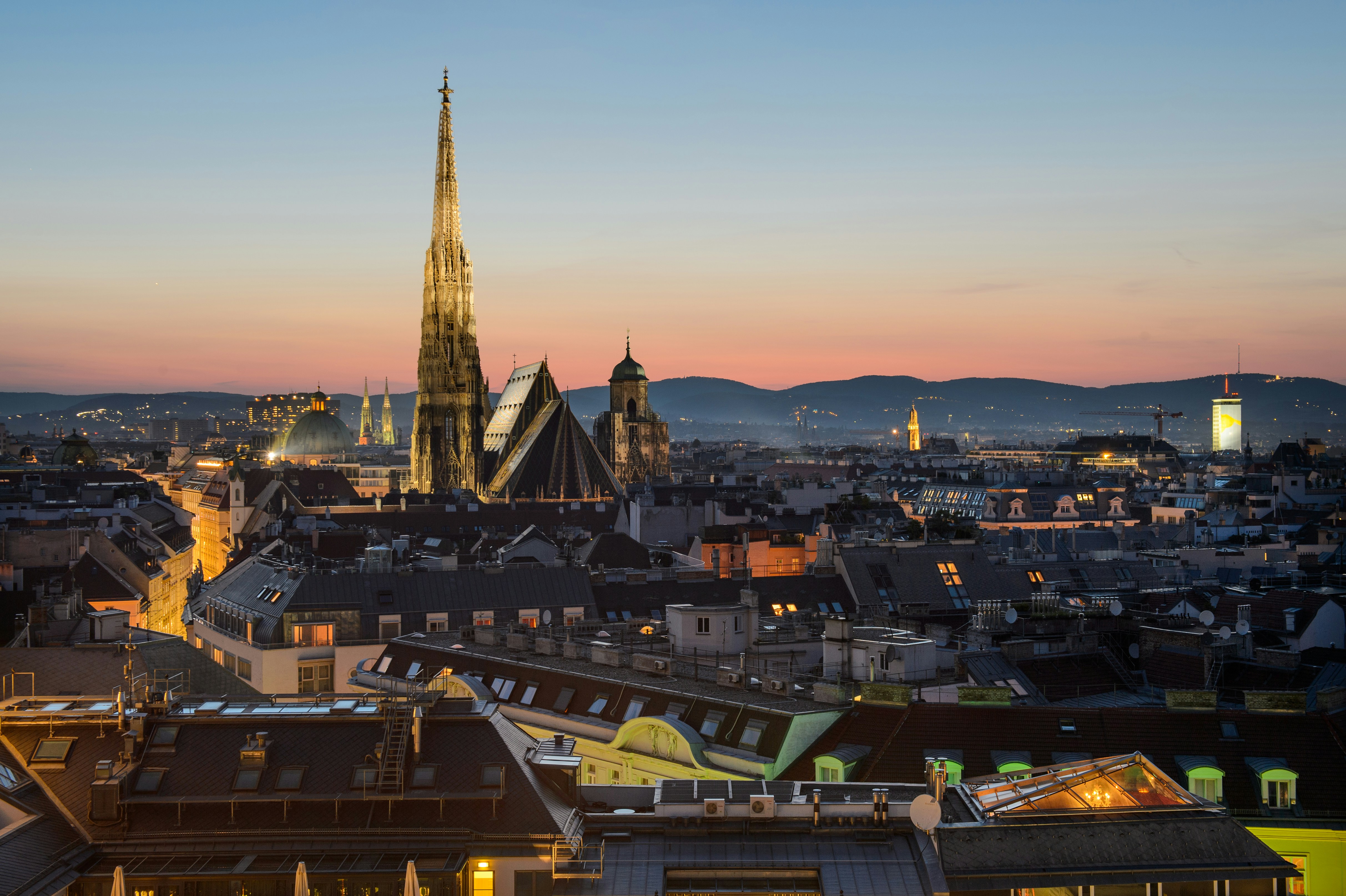
Vienna keeps showing up at the top of every "best cities to live in" ranking, and there's a good reason for that. The city combines career opportunities, affordable living (by Western European standards), and a quality of life that's hard to beat anywhere on the continent.
If you're thinking about making the move, here's what you actually need to know — from visas and salaries to healthcare and daily life.
Key Facts at a Glance
| Detail | Info |
|---|---|
| Population | ~2 million (37% foreign citizens) |
| Language | German (English common in tech/international firms) |
| Currency | Euro (EUR) |
| Quality of life | Consistently top 3 globally (EIU, Mercer) |
| Work visa options | Red-White-Red Card, EU Blue Card |
| Average IT salary | EUR 58,000–72,000/year |
| Monthly cost (single) | EUR 1,400–2,100 |
| Annual transit pass | EUR 467 |
| Vacation days | 25 days + 13 public holidays |
| Monthly salary payments | 14 per year (13th and 14th month bonus) |
Why Vienna Stands Out
Vienna has been ranked among the top 3 most livable cities in the world for years running, by both the Economist Intelligence Unit and Mercer. It scored a perfect 100 for healthcare, education, and infrastructure in the EIU's 2025 index.
But beyond the rankings, what makes Vienna attractive for professionals is the combination of factors you rarely find in one place:
- A strong job market, especially in IT, engineering, finance, and healthcare
- A cost of living significantly lower than London, Paris, Zurich, or Amsterdam
- World-class public transport for under EUR 1.30 a day
- 38 days of paid time off per year (vacation + public holidays)
- A healthcare system that actually works without bankrupting you
- Central European location — Berlin, Munich, Budapest, and Milan are all a short train ride away
Nearly 40% of Vienna's population was born outside Austria, and 182 nationalities call the city home. If you're worried about fitting in as a foreigner, Vienna is about as international as it gets.
How to Get a Work Visa for Austria
Non-EU citizens have two main routes into Austria's job market: the Red-White-Red (RWR) Card and the EU Blue Card.
Red-White-Red Card
This is Austria's points-based work permit, and it comes in a few flavours depending on your profile:
- Skilled workers in shortage occupations: You need a job in a listed shortage field, at least 55 points on Austria's scoring system, and a minimum salary of EUR 3,465 per month gross (2026 threshold)
- Other key workers: Same 55-point minimum and salary floor, but for roles not on the shortage list
- Very highly qualified workers: 70 points required — aimed at PhDs, senior researchers, and executives
Points are awarded based on your qualifications, work experience, language skills (German and English both count), and age (younger applicants score higher).
The RWR Card is initially valid for 24 months and is tied to your employer. After that, you can apply for the RWR Card Plus, which gives you an open work permit — meaning you can switch jobs freely. Processing takes around 8 weeks, sometimes longer.
EU Blue Card
If you have a university degree and a job offer paying at least EUR 55,678 per year (2026 threshold), the EU Blue Card is your fastest route. It's valid for up to two years, and after 12 months you can move to another EU country.
The Blue Card doesn't use a points system — it's simpler. Degree plus salary threshold plus job offer, and you're in.
Both visa types allow family reunification. Your spouse and dependent children can join you in Austria and receive their own residence permits. Always check the latest requirements on migration.gv.at — thresholds change annually.
Salaries in Vienna: What to Expect
Vienna salaries are lower than London or Zurich on paper, but the cost of living is dramatically lower too. Net purchasing power is competitive, and there's one thing Austria does that most countries don't: you get paid 14 times a year.
The 13th and 14th month salaries are standard in Austria (legally mandated through collective agreements). Even better, they're taxed at a flat 6% instead of your regular income tax rate. That's a significant bump to your take-home pay.
Typical gross annual salaries in Vienna:
- Software engineer: EUR 58,000–72,000 (senior roles at top companies can exceed EUR 90,000)
- Finance professional: EUR 55,000–75,000
- Engineer (general): EUR 50,000–65,000
These figures already include the 13th and 14th month payments. Keep in mind that the job market has become more competitive in 2025–2026, with unemployment ticking up slightly. That said, demand in IT, healthcare, and engineering remains solid.
Cost of Living in Vienna
Vienna is often described as offering Western European quality at Central European prices. Compared to other cities that rank this high on liveability indexes, it's genuinely affordable.
Housing
- 1-bedroom apartment (city centre): EUR 1,000–1,500/month
- 1-bedroom apartment (outside centre): EUR 700–1,000/month
- Utilities (electricity, heating, water): EUR 150–250/month
- Internet: EUR 30–50/month
Rents have been climbing about 5% per year recently, but they're still well below what you'd pay in comparable Western European capitals.
Daily Expenses
- Groceries (single person): EUR 250–350/month
- Lunch out: EUR 10–15
- Dinner for two (mid-range restaurant): EUR 70
- Coffee (cappuccino): EUR 4.30–4.50
Monthly Budget Summary
- Single person: EUR 1,400–2,100 (including rent)
- Couple or small family: EUR 2,500–3,500 (including rent)
For Americans coming from San Francisco, New York, or Boston, Vienna will feel remarkably affordable. You get a lot more for your money here.
Healthcare in Austria
Austria's healthcare system is one of the best in Europe, and it works very differently from the US.
When you start working, you're automatically enrolled in public health insurance. Your employer handles the registration, and contributions are split roughly 50/50 — you pay about 3.87% of your gross salary for health insurance.
You'll receive an e-card, which is essentially your insurance ID. Show it at any doctor's office and you're covered. No upfront payments, no claim forms, no deductibles, no "in-network" versus "out-of-network" confusion. Doctor visits, hospital stays, prescriptions, and specialist care are all included.
One thing that surprises Americans: you don't choose your public insurer. It's determined by your employer and industry. But the coverage is standardised and comprehensive across the board.
Many professionals also carry private supplementary insurance (roughly EUR 100–300/month), which gives you shorter waiting times, more choice of doctors, and private hospital rooms. Some employers offer this as a benefit.
Taxes: What You'll Actually Pay
Austria has a progressive income tax system. Here's what the 2026 brackets look like:
| Taxable Income (EUR/year) | Tax Rate |
|---|---|
| Up to 13,541 | 0% |
| 13,541–21,992 | 20% |
| 21,992–36,458 | 30% |
| 36,458–70,365 | 40% |
| 70,365–104,859 | 48% |
| 104,859–1,000,000 | 50% |
On top of income tax, employees pay about 18% in social security contributions (pension, health, unemployment), capped at a monthly gross of EUR 6,450.
For a typical professional earning EUR 60,000 gross, the effective total deduction (income tax plus social security) works out to roughly 33–35%. That's comparable to Germany and lower than Belgium or Denmark.
A few things that work in your favour:
- The 13th and 14th month bonuses are taxed at just 6%, not your regular rate
- Austria has no wealth tax, no inheritance tax, and no gift tax
- Tax brackets are adjusted for inflation each year (1.73% adjustment for 2026)
Vienna's Tech and Startup Scene
Vienna's tech ecosystem has been growing fast. It's ranked in the top 75 startup ecosystems globally, with over 605 startups and more than EUR 1.2 billion in total funding.
Some names you might recognise:
- Bitpanda — one of Europe's leading crypto and fintech platforms
- GoStudent — edtech unicorn
- Dynatrace — software intelligence company, publicly traded on the NYSE
- Storyblok — headless CMS gaining global traction
- Refurbed — refurbished electronics marketplace
The Vienna Business Agency actively supports international professionals and founders. There's even a dedicated Startup Package for people moving to Vienna to launch a company. And with the new FlexCo company structure, incorporating a startup in Austria is simpler than ever.
Vienna also works well as a gateway to Central and Eastern European markets — a lot of international companies set up their CEE headquarters here.
Work-Life Balance and Labour Laws
This is where Austria really shines, especially if you're coming from the US.
Time Off
- Annual leave: 25 paid vacation days (increases to 30 after 25 years of service)
- Public holidays: 13 per year
- Total: 38 days of paid time off per year
For comparison, the average American gets about 11 days of PTO plus 7 federal holidays. Austria gives you more than double.
Working Hours
The standard working week is 40 hours (8 hours per day). Overtime must be compensated — either paid at 150% of your regular rate or given as time off in lieu. The "always available" culture that's common in the US simply doesn't exist here.
Parental Leave
Austria offers some of the most generous parental leave in Europe:
- Maternity leave: 16 weeks (8 before, 8 after birth) at full pay
- Paternity leave: Up to 1 month, available any time before the child turns 2
- Childcare allowance (Kinderbetreuungsgeld): Two options — a flat-rate model (EUR 17–41 per day for 12–35 months) or an income-related model (80% of salary, capped at EUR 2,000/month, for up to 14 months when shared between parents)
There's also Familienbeihilfe (family allowance) — a monthly payment for each child, regardless of income.
Getting Around Vienna
Vienna's public transport system is one of the best in Europe, and it's absurdly affordable.
The network includes 5 metro lines, 28 tram lines, 134 bus routes, and suburban rail — covering the entire city. During peak hours, trains come every 2–5 minutes. About 70% of Viennese use public transport daily.
An annual pass costs EUR 467 (EUR 461 for the digital version). That works out to EUR 1.28 per day for unlimited travel across the entire network. If you're under 26, the youth pass is EUR 300.
If you want to travel across all of Austria by public transport, the KlimaTicket covers every train, bus, and tram in the country for about EUR 1,095 per year.
Most expats in Vienna don't own a car. Between the transit system, cycling infrastructure, and the city's walkability, you simply don't need one.
The International Community
Vienna doesn't just tolerate foreigners — it's built around them. About 37% of the city's population doesn't hold Austrian citizenship, and over 40% were born abroad. You'll hear dozens of languages on any given U-Bahn ride.
In the tech and startup world, English is the working language at most international companies. For government services and daily life, though, German is still essential. Having even basic German will make everything smoother — from registering your address to chatting with your neighbours.
The city has a well-established expat infrastructure: international schools, relocation services, multilingual administration staff, and a vibrant community of professionals from around the world.
Frequently Asked Questions
Do I need to speak German to work in Vienna? It depends on the industry. Most international tech companies, startups, and multinational firms use English as their working language. But for daily life — shopping, dealing with authorities, socialising — basic German goes a long way. Many employers offer free German courses as a benefit.
How long does it take to get a Red-White-Red Card? The official processing time is about 8 weeks from a complete application. In practice, it can take longer depending on your local Austrian embassy or consulate. Start the process well before your planned move date.
Is Vienna expensive compared to other European capitals? Not at all, relative to its quality of life. Vienna is significantly cheaper than London, Paris, Zurich, and Amsterdam. It's comparable to Berlin and considerably cheaper than Munich. You get top-tier infrastructure and services at mid-range European prices.
Can my family move with me to Austria? Yes. Both the Red-White-Red Card and the EU Blue Card allow family reunification. Your spouse and dependent children can apply for their own residence permits and have full access to Austria's healthcare and education systems.
What's the path to permanent residency? After five years of continuous legal residence in Austria, you can apply for permanent residency (Daueraufenthalt-EU). You'll need to demonstrate German language skills (B1 level), stable income, and health insurance coverage.
Is it easy to travel around Europe from Vienna? Extremely. Vienna is centrally located — Budapest is 2.5 hours by train, Munich is 4 hours, Prague is 4 hours, and you can fly to most European capitals in under 2 hours. The Schengen Area means no passport checks for travel within most of Europe.
Moving to Vienna isn't just about finding a job in Europe — it's about building a life in a city that genuinely prioritises quality of living. From the healthcare system to the 38 days of annual leave, from the affordable transit pass to the thriving international community, Vienna consistently delivers on the things that matter most.
At Move2Europe, we help skilled professionals through exactly this process — from understanding your visa options to preparing your documents and settling in.
Book a free consultation and let's figure out your fastest path to Vienna.
Official sources:
- migration.gv.at — Austrian immigration portal (visa types, requirements, thresholds)
- oesterreich.gv.at — Austrian government services portal
- wien.gv.at — City of Vienna official site (population, integration data)
- wienerlinien.at — Vienna public transport (fares, network info)
- bundeskanzleramt.gv.at — Austrian family benefits
- Numbeo — Cost of living comparison data