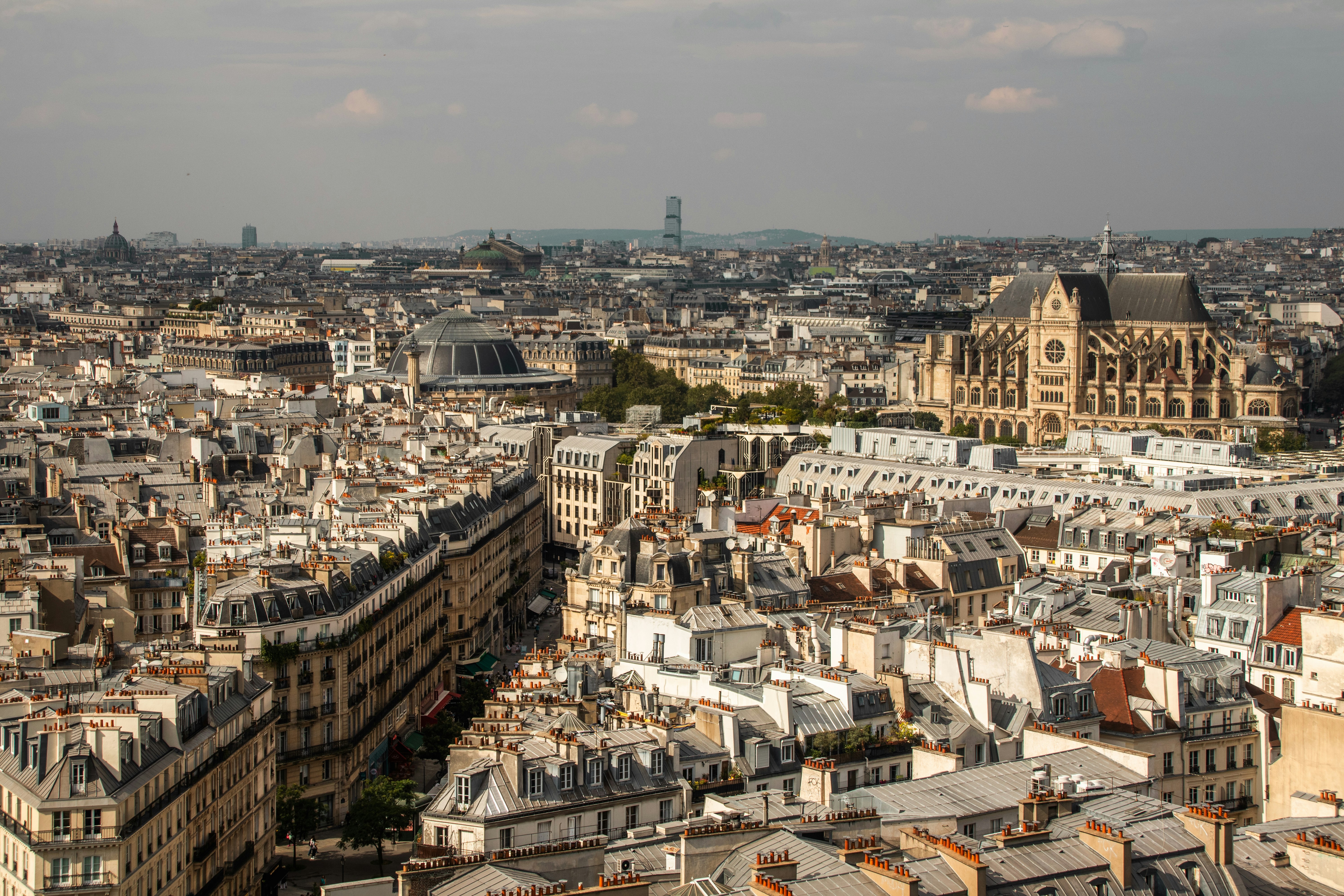
France has a way of making the shortlist for almost everyone thinking about Europe. The food, the culture, the five weeks of vacation — it all sounds great on paper. And for professionals, especially in tech, aerospace, finance, and luxury goods, the career opportunities are genuinely strong.
But France also has a reputation for bureaucracy, high taxes, and a job market that's hard to crack without French. Here's a practical look at what it actually takes to move there, what you'll earn, and what daily life looks like.
Key Facts at a Glance
| Detail | Info |
|---|---|
| Population | ~68 million |
| Language | French (English common in tech/multinationals) |
| Currency | Euro (EUR) |
| Economy | 7th largest globally, 3rd in the EU |
| Work visa | Talent Passport, VLS-TS, EU Blue Card |
| Talent Passport salary threshold | EUR 39,582/year |
| EU Blue Card threshold | EUR 59,373/year |
| Average IT salary (Paris) | EUR 55,000–79,000/year gross |
| Legal work week | 35 hours |
| Total time off | Up to ~48 days/year (vacation + RTT + holidays) |
| Navigo pass (Paris transit) | EUR 90.80/month |
Visa Options
France doesn't have a one-size-fits-all work visa. The right route depends on your qualifications, salary, and what you're coming to do.
Talent Passport (Passeport Talent)
This is France's flagship permit for skilled professionals, and it's the most attractive option. It's a multi-year residence permit (up to 4 years, renewable) with several subcategories:
- Qualified Employee: Minimum gross salary of EUR 39,582/year. Requires a master's degree or equivalent and a job contract of at least 3 months.
- EU Blue Card: Minimum EUR 59,373/year (1.5x the national average). Requires a university degree and a job offer of at least 12 months.
- Employee on Assignment: Same EUR 39,582 threshold, for intra-company transfers.
- French Tech Visa: For founders, investors, and employees of companies backed by the La French Tech program.
- Researcher/Artist/Entrepreneur: Additional subcategories with different requirements.
The Talent Passport includes family reunification — your spouse gets an automatic work permit.
Long-Stay Visa (VLS-TS)
This visa acts as both your entry visa and your first-year residence permit. Most Talent Passport holders enter France on a VLS-TS and then apply for the multi-year card. You must validate it online within 3 months of arrival.
Standard Work Visa (Salarié)
For roles that don't meet the Talent Passport thresholds. Your employer needs to obtain labour market authorisation — proving no qualified French or EU candidate is available. More paperwork, slower process.
France does NOT have a digital nomad visa. Since June 2025, French authorities have been actively cracking down on remote work on visitor (visiteur) visas. If you're a remote worker for a foreign company, France is not straightforward — you'd need to explore the Profession Libérale (freelancer) visa or get hired by a French entity. Don't assume you can just show up and work remotely.
What You'll Earn
French salaries are quoted as gross annual (brut annuel). The gap between gross and net is larger than what Americans expect — employee social contributions take roughly 22–25% off the top before income tax.
Typical gross annual salaries:
- Software engineer (Paris): EUR 55,000–79,000 (senior roles above EUR 80,000)
- Software engineer (national): EUR 45,000–70,000
- Finance professional: EUR 50,000–75,000 (senior roles above EUR 90,000)
- Engineering (general): EUR 42,000–65,000
- National average salary: ~EUR 42,800/year gross
- SMIC (minimum wage, 2026): EUR 1,823/month gross (~EUR 1,443 net)
Paris pays a 15–25% premium over the rest of France for most professional roles.
Cost of Living
France varies wildly by city. Paris is expensive by any standard. The rest of the country is far more affordable.
Rent (1-bedroom apartment)
| City | City centre | Outside centre |
|---|---|---|
| Paris | EUR 1,200–1,600 | EUR 900–1,200 |
| Lyon | EUR 650–1,200 | EUR 500–800 |
| Nice | EUR 800–1,200 | EUR 600–900 |
| Bordeaux | EUR 700–1,000 | EUR 500–750 |
| Toulouse | EUR 600–900 | EUR 450–700 |
| Marseille | EUR 600–800 | EUR 450–650 |
Other Monthly Costs
- Groceries (single person): EUR 250–400
- Utilities (electricity, heating, water, internet): EUR 150–250
- Paris Navigo pass (all zones): EUR 90.80 (employer reimburses at least 50%, often 75–100%)
- Dining out (2 people, mid-range): EUR 60–75
- Coffee (espresso): EUR 2–3
- Baguette: EUR 1.20–1.50
Monthly Budget Summary
- Single person (Paris): EUR 2,200–3,200 including rent
- Single person (Lyon/Bordeaux): EUR 1,400–2,200 including rent
- Single person (smaller cities): EUR 1,100–1,800 including rent
Paris is expensive, but the employer transit reimbursement, subsidised company lunches (tickets restaurant), and the healthcare system offset some of that cost.
Housing
Finding a place to rent in Paris is notoriously competitive. The vacancy rate is 1–2%, and landlords require an extensive dossier:
- 3 months of pay slips
- Employment contract
- Tax returns
- ID and proof of current address
- A French guarantor (garant) — or use Visale, a free government-backed guarantee service for eligible newcomers
Leases are 3 years for unfurnished apartments and 1 year for furnished. Security deposits are capped at 1 month's rent (unfurnished) or 2 months (furnished).
Outside Paris, the rental market is much more relaxed. Lyon, Bordeaux, Toulouse, and Marseille all have reasonable supply and faster turnaround times.
Start your apartment search before arriving. Peak season is late August–September (student demand) and January (new jobs). Having your dossier ready in advance gives you a significant edge.
The 35-Hour Work Week (and Why It's Better Than It Sounds)
France's legal work week is 35 hours. In practice, most professionals work 37–39 hours and get compensated with RTT days (réduction du temps de travail) — extra days off that accumulate throughout the year.
Here's how the time off stacks up:
- Paid vacation: 25 working days (5 weeks), statutory minimum
- RTT days: ~9–15 extra days per year (depending on how many hours above 35 you work)
- Public holidays: 11 per year
- Total: Up to ~48 days of paid time off per year
That's not a typo. Between vacation, RTT, and public holidays, many French professionals take nearly 10 weeks off annually. Coming from the US, where 15 days PTO is considered generous, this is a different world.
Other work culture highlights:
- Right to disconnect: Companies with 50+ employees must have policies on after-hours email. Your boss emailing you at 9 PM on Saturday is not normal here.
- Lunch breaks: Typically 1–2 hours. Eating a sandwich at your desk is considered sad, not productive.
- "Cadre" status: Senior professionals (cadres) often work under a "forfait jours" agreement — 218 working days per year instead of hourly tracking. More autonomy, but also more expected flexibility.
Taxes
France has a progressive income tax system, but with a twist: the family quotient system (quotient familial) divides your household income by "shares" based on family composition. Single = 1 share, married couple = 2 shares, each child adds 0.5 (first two) or 1 (third onward). This significantly reduces the effective rate for families.
2025/2026 Tax Brackets (per share)
| Taxable Income (per share) | Rate |
|---|---|
| Up to EUR 11,497 | 0% |
| EUR 11,498–29,315 | 11% |
| EUR 29,316–83,823 | 30% |
| EUR 83,824–189,294 | 41% |
| Above EUR 189,294 | 45% |
On top of income tax, employees pay CSG/CRDS social contributions of about 9.7% on most of their salary. And roughly 13–15% more goes to pension and other social security contributions. The total employee deduction from gross salary is around 22–25%.
A few other things to know:
- There's a high-income surtax of 3% on income above EUR 250,000 (single) and 4% above EUR 500,000
- France has a real estate wealth tax (IFI) on property assets above EUR 1.3 million — but it does not apply to financial assets, stocks, or business wealth
- Capital gains on securities are taxed at a flat 30% (the "PFU" or flat tax)
- Tax filing is annual and based on the previous year's income
Healthcare
France's healthcare system is consistently ranked among the best in the world, and as an employed expat, you're part of it.
Once you've been legally resident for 3 months, you're covered by PUMa (Protection Universelle Maladie) — France's universal healthcare system. You register with your local CPAM and receive a Carte Vitale, your health insurance card.
The system reimburses about 70% of standard medical costs (GP visits, specialists, prescriptions, hospital stays). To cover the remaining 30%, virtually everyone in France has a mutuelle — a complementary private insurance. Employers are legally required to offer one to employees since 2016. Typical cost: EUR 30–80/month, often partially paid by the employer.
In practice, with Sécurité Sociale plus a mutuelle, you pay very little out of pocket. A GP visit costs about EUR 26.50, of which you'd typically pay EUR 1–2 after reimbursements.
The Tech Scene
France's tech ecosystem has grown enormously over the past decade. Paris is now one of Europe's top startup hubs, and the government actively supports the sector through La French Tech and programmes like the French Tech Visa.
The centrepiece is Station F — the world's largest startup campus, hosting over 1,000 startups in Paris. About 70% of current Station F companies are focused on AI.
France has around 30 unicorns, including:
- Doctolib — healthtech, valued at EUR 6.4 billion
- Mistral AI — artificial intelligence, EUR 6.2 billion
- Back Market — refurbished electronics marketplace, EUR 5.7 billion
- Qonto — business banking for SMEs
- Vestiaire Collective — luxury fashion resale
- Pennylane — accounting fintech, reached EUR 2 billion valuation in 2026
French startups raised EUR 8.2 billion in 2025. AI and climate-tech are leading the next wave of investment.
Beyond startups, France is home to global industrial giants: Airbus (aerospace, Toulouse), LVMH (luxury, Paris), Renault and Stellantis (automotive), Sanofi (pharma), and Thales and Dassault (defence). Paris is also positioning itself as the EU's leading financial centre post-Brexit, with banks like JP Morgan, Goldman Sachs, and Bank of America expanding their Paris operations.
Getting Around
Paris has one of the best public transport systems in the world — Metro, RER (suburban rail), buses, and trams cover the entire Ile-de-France region.
The Navigo monthly pass costs EUR 90.80 and covers unlimited travel on everything — Metro, RER, buses, and trams across all zones. Your employer is legally required to reimburse at least 50%, and many reimburse 75–100%. That could bring your actual cost down to EUR 22–45/month.
For getting around France, the TGV high-speed rail network is excellent. Paris to Lyon takes 2 hours, Paris to Marseille 3 hours, Paris to Bordeaux 2 hours. Budget options like OUIGO (SNCF's low-cost TGV service) start around EUR 19–30 for advance bookings.
Most major cities also have bike-sharing systems (Vélib' in Paris) and scooter rentals.
Language
This is the honest truth: you can get hired in France without French, especially in tech, at multinationals, and in Paris's startup ecosystem. Station F operates largely in English. Companies like Doctolib, Qonto, and many international firms use English as their working language.
But daily life in France runs on French. Government offices, landlords, utility companies, doctors, tax forms — it's all in French. Outside Paris, English proficiency drops off considerably.
You don't need French to get started. But you'll need it to thrive. Most expats who stay long-term reach B1–B2 level within a year or two, especially with the immersion of daily life. There's no formal French language requirement for the Talent Passport or EU Blue Card.
French Culture: What to Expect
A few things that surprise newcomers:
- Always say "Bonjour" when entering a shop, cafe, or any interaction. Skipping it is considered genuinely rude — not just impolite, but a social transgression.
- Business meetings are more formal than in the US or Northern Europe. Titles matter. Punctuality matters (though lunch may run long).
- The lunch break is sacred. Many companies have subsidised cafeterias (cantine) or provide tickets restaurant (meal vouchers worth EUR 9–13/day).
- August is quiet. Much of France takes vacation in August. Many smaller businesses simply close. Plan around it.
- Strikes happen. Transport strikes are a regular feature of French life. They're usually announced in advance, and minimum service is maintained on public transport.
Frequently Asked Questions
Does France have a digital nomad visa? No. France does not offer a dedicated digital nomad visa, and since June 2025, authorities have been cracking down on remote work on visitor visas. If you want to work remotely from France, you'll need to explore the Profession Libérale (freelancer) visa or find a French employer willing to sponsor a Talent Passport.
How much tax will I actually pay? It depends on your family situation (thanks to the quotient familial). A single person earning EUR 60,000 gross would pay roughly 22–25% in social contributions plus about 10–15% effective income tax. Total take-home is around 60–65% of gross salary. Families with children pay significantly less in income tax.
Is Paris worth the higher cost of living? For career opportunities, networking, and the tech ecosystem — yes. Paris has the most international companies, the best public transport, and the richest cultural life. But Lyon, Bordeaux, Toulouse, and Nantes offer excellent quality of life at 30–50% lower costs, with growing job markets in tech and industry.
How long does the Talent Passport take? Consular processing typically takes several weeks. Once in France, you validate your VLS-TS online within 3 months, then apply for the multi-year card before your first year expires. Total timeline from application to receiving your card: 2–4 months.
Can my family come with me? Yes. The Talent Passport includes family reunification. Your spouse receives an automatic work permit, and children get access to the French education system (public schools are free).
What's the path to permanent residency? After 5 years of continuous legal residence, you can apply for a 10-year resident card (carte de résident). French citizenship requires at least 5 years of residence, French language skills (B1 level), and demonstrated integration.
France isn't the easiest country to move to — the bureaucracy is real, the tax system is complex, and the language barrier matters. But for professionals who make it through the setup phase, the rewards are hard to beat: a world-class healthcare system, nearly 50 days off per year, a thriving tech ecosystem, and a quality of life that the French have spent centuries perfecting.
At Move2Europe, we help skilled professionals navigate the full relocation process — from choosing the right visa route to getting settled in your new city.
Book a free consultation and let's figure out your path to France.
Official sources:
- france-visas.gouv.fr — French visa application portal
- service-public.fr — French government services (tax, housing, healthcare)
- welcometofrance.com — French government's talent attraction portal
- ameli.fr — French health insurance (CPAM/PUMa)
- impots.gouv.fr — French tax administration
- Numbeo — Cost of living data