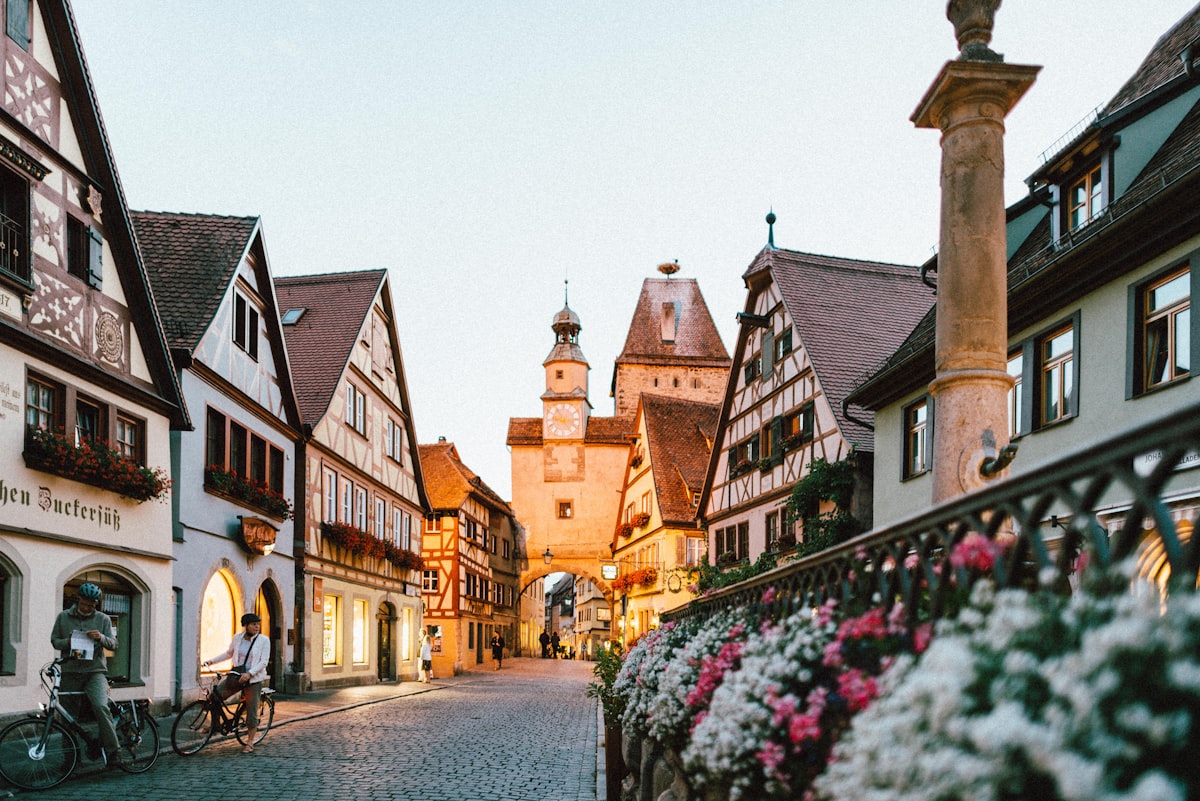
If you're moving to Germany from the US, one of the first things you'll notice is how deeply sustainability is woven into everyday life. This isn't a niche concern or a political talking point — it's just how things work here. You'll separate your trash into five bins, return bottles for deposit refunds, and commute on trains powered increasingly by wind and solar.
Germany is one of the greenest countries in the world by most measures: top 10 in the Environmental Performance Index, the highest recycling rate globally, and a national energy transition (the Energiewende) that's already made renewables the majority of the country's electricity. For expats who care about sustainability — or just want to understand how daily life works — here's what to expect.
Renewable Energy: The Energiewende
Germany's Federal Climate Change Act (updated 2021) sets a target of climate neutrality by 2045 — five years ahead of the EU-wide goal. The intermediate targets are ambitious: 65% emissions reduction by 2030 and 88% by 2040, both measured against 1990 levels.
The progress is real. In 2024, renewable sources generated roughly 58% of Germany's electricity — up from about 46% in 2022. Wind power (onshore and offshore) contributes about 30-33%, solar around 13-15%, and biomass another 8-9%. Nuclear power dropped to 0% after the last three plants shut down in April 2023.
Many German households install rooftop solar panels and feed excess electricity back into the grid under the EEG (Renewable Energy Act). In apartment buildings, "Balkonkraftwerke" (balcony power stations) — small plug-in solar panels — have become increasingly popular, with hundreds of thousands installed across the country.
Coal still accounts for about 20-23% of electricity generation, and Germany's exit timeline (officially 2038, with political ambitions for 2030) remains contentious. But the direction is clear — renewables have crossed the majority threshold and are growing every year.
Recycling: Five Bins and a Deposit System
Germany's recycling rate of approximately 67% is among the highest in the world. If you're coming from a country where everything goes in one bin, prepare for a learning curve.
German waste separation works like this:
- Blue bin (Papiertonne): Paper and cardboard
- Yellow bin or bag (Gelber Sack): Packaging — plastics, metals, Tetra Pak
- Brown bin (Biotonne): Organic waste — food scraps, garden waste
- Black bin (Restmüll): Everything else that can't be recycled
- Glass containers: Sorted by colour — clear (Weißglas), green (Grünglas), brown (Braunglas). Located at neighbourhood collection points, not at your home.
Getting it wrong will earn you a note from your neighbours or, in some cities, a fine. Germans take this seriously.
The Pfand System
The bottle deposit system (Pfand) is one of Germany's most visible sustainability features. When you buy beverages, you pay a deposit that you get back when you return the container:
- Single-use PET bottles and cans: EUR 0.25 deposit
- Reusable glass bottles: EUR 0.08-0.15 deposit (depending on the type)
Return machines (Pfandautomaten) are in every supermarket. The system achieves return rates above 95% for single-use containers. Since January 2024, the deposit also applies to milk beverage containers, closing a previous loophole.
You'll see "Pfandsammler" — people who collect discarded bottles in public spaces to return for the deposit. Many Germans leave bottles next to public bins rather than throwing them away, specifically so collectors can reach them. It's an informal social contract.
Public Transport and the Deutschlandticket
Germany's public transport network is extensive — trains, trams, buses, and metros connect cities and towns across the country. And the Deutschlandticket makes it remarkably affordable.
Introduced in 2023 at EUR 49/month, the Deutschlandticket covers unlimited travel on all regional and local public transport nationwide — S-Bahn, U-Bahn, trams, buses, and regional trains. The price increased to EUR 58/month in 2025. It doesn't cover ICE or IC long-distance trains, but for daily commuting and regional travel, it's one of the best transit deals in Europe.
The ticket has over 11 million active subscribers. For expats, it means you can live in one city, visit another on weekends, and commute daily — all on a single monthly pass that costs less than a weekly transit pass in most US cities.
Cycling
Cycling is a genuine mode of transport in Germany, not just recreation. Most cities have dedicated bike lanes, secure parking, and bike-sharing systems (like Call a Bike from Deutsche Bahn). Freiburg, Münster, and Karlsruhe are among the most bike-friendly cities in Europe.
Many employers offer subsidised bike leasing through JobRad — you get a new bike through your employer at a tax advantage, paid through monthly salary deductions. It's the cycling equivalent of a company car.
Electric Vehicles
Germany had over 1.5 million battery electric vehicles on its roads by late 2025, with over 120,000 public charging points (tracked by the Bundesnetzagentur). The government's purchase subsidy (Umweltbonus) ended in December 2023, which slowed growth, but the charging infrastructure continues to expand toward a target of 1 million public charging points by 2030.
If you're bringing or buying a car, know that many German city centres are establishing or expanding low-emission zones (Umweltzonen) — you'll need a green emissions sticker (Umweltplakette) to drive in them.
Food and Sustainability Culture
The German approach to food reflects the same environmental consciousness. Organic (Bio) products are mainstream, not a premium niche. You'll find them in every supermarket, and there are dedicated organic chains:
- Alnatura — the largest organic supermarket chain, with over 150 stores
- Denn's Biomarkt — another major organic chain
- Bio Company — concentrated in Berlin and surrounding areas
Weekly farmers' markets (Wochenmarkt) are a fixture in nearly every German neighbourhood, offering local, seasonal produce directly from regional farms. Shopping at the Wochenmarkt is a social ritual as much as a grocery run.
Zero-waste stores (Unverpackt-Läden) are growing across German cities — you bring your own containers and buy everything from pasta to shampoo without packaging. There are over 300 across the country.
Germany is also a leader in food waste reduction. The country generates about 11 million tonnes of food waste annually, and multiple initiatives are tackling it:
- Too Good To Go — the surplus food app is extremely popular here
- Foodsharing.de — a Germany-specific platform with over 200,000 active "Foodsavers" who rescue and redistribute surplus food
- Tafel — a network of over 960 food banks redistributing surplus from supermarkets and restaurants
Green Spaces and Nature
German cities are designed with green space in mind. Even dense urban areas have large parks, tree-lined streets, and access to nature that would surprise anyone coming from US cities.
The numbers back it up:
- 16 national parks — from the Bavarian Forest to the Wadden Sea
- 16 UNESCO Biosphere Reserves
- Over 100 nature parks covering roughly 28% of Germany's land area
- Over 1 million Kleingärten — allotment garden plots where city residents grow vegetables, flowers, and spend weekends in small garden sheds
Kleingärten (also called Schrebergärten) are uniquely German. You rent a small plot in a community garden, usually for EUR 200-400/year, and it becomes your personal green retreat. There are waiting lists in many cities — especially Berlin and Hamburg — but the tradition is alive and well.
City forests (Stadtwald) are common. Frankfurt's Stadtwald is 48 square kilometres. Munich has the Englischer Garten, one of the largest urban parks in the world. Berlin has the Tiergarten, Grunewald forest, and Tempelhofer Feld — a former airport turned into one of Europe's largest open urban spaces.
Green Buildings
Germany has some of the strictest building energy standards in Europe. The Gebäudeenergiegesetz (Building Energy Act, or GEG) sets minimum requirements for insulation, heating efficiency, and renewable energy use in buildings.
The biggest recent change: since January 2024, new heating systems installed in new construction must run on at least 65% renewable energy. For existing buildings, the requirement phases in based on municipal heat planning timelines — large cities by mid-2026, smaller municipalities by mid-2028. In practice, this means a shift from gas boilers toward heat pumps, district heating, and other renewable systems.
When renting or buying property, every building must have an Energieausweis (Energy Performance Certificate) that shows its energy efficiency. Look for this before signing a lease — it directly affects your heating costs.
Germany also originated the Passivhaus (passive house) standard — ultra-efficient buildings that need almost no active heating or cooling. Freiburg's Vauban district is a globally recognised model for sustainable urban development: car-free streets, passive houses, community solar, and green roofs.
The Greenest Cities
A few cities stand out for sustainability:
Freiburg is often called Germany's green capital. It gets more sunshine than almost any other German city, and it uses it — the solar industry is a major employer. The Vauban district is a global model. The city aims for climate neutrality by 2035.
Hamburg was the European Green Capital in 2011. The HafenCity development is one of Europe's largest urban sustainability projects, and the city has invested heavily in cycling infrastructure and green transport.
Munich's municipal utility (Stadtwerke München) set out to power the entire city with renewable electricity. The city also has one of Germany's most extensive district heating networks.
Berlin has the Berliner Energiewendegesetz setting a 2045 climate neutrality target, massive cycling expansion, and a culture of environmental activism that shapes policy from the ground up.
What Surprises Expats
A few things that catch newcomers off guard:
- Shops close on Sundays. Almost all retail is closed on Sundays and public holidays (Ladenschlussgesetz). This reduces energy consumption and gives workers guaranteed time off. Plan your grocery shopping accordingly.
- No air conditioning. Most German homes and many offices don't have AC. Buildings are designed to stay cool through thick walls, shutters, and cross-ventilation. Summers are getting hotter, which is making this a growing pain point.
- Paper is everywhere. Despite the digital leadership in many areas, Germany still runs on paper for many official processes — contracts, tax documents, letters from your health insurer. The Fax machine is not yet dead here.
- Energy costs are high. Germany has some of the highest electricity prices in Europe, partly because of levies that fund the renewable energy transition. This is one reason efficiency is taken so seriously — turning off lights and heating consciously isn't just environmental, it's financial.
- Quiet hours (Ruhezeiten). Noise regulations are strict. No loud music or drilling on Sundays or after 10 PM. Mowing your lawn on Sunday will get you reported. This is partly cultural, partly environmental — noise pollution is taken as seriously as other forms.
Frequently Asked Questions
Do I have to separate my recycling? Yes. Waste separation is mandatory in Germany, not optional. The specific bin system varies slightly by municipality, but the five-category system (paper, packaging, organic, glass, residual) is universal. Fines for improper sorting exist, though they're rarely enforced for individuals — social pressure is usually enough.
Is the Deutschlandticket worth it? If you use public transport more than a few times per month, yes. At EUR 58/month (2025 price), it covers all local and regional public transport nationwide. For daily commuters, it's a no-brainer. Even for occasional use, it often pays for itself.
How expensive is organic food in Germany? More affordable than in the US. Organic (Bio) products typically cost 20-40% more than conventional equivalents — but conventional German food is already held to higher standards than in many countries (strict EU regulations on pesticides, hormones, and antibiotics). Budget-friendly organic options are available at Aldi and Lidl, which have extensive Bio ranges.
Can I survive without a car? Absolutely — especially in major cities. Germany's public transport, cycling infrastructure, and walkable city centres make car-free living practical. The Deutschlandticket covers regional travel, and car-sharing services (ShareNow, SIXT share) handle the occasional need for a vehicle. About 30% of Berlin households don't own a car.
Germany's sustainability isn't performative — it's structural. The infrastructure, regulations, and cultural norms all push in the same direction. For expats who've been frustrated by the lack of public transit, recycling options, or green space in their home cities, Germany can feel like a revelation. The trade-offs are real (Sunday closures, high energy costs, no AC), but for many, the green lifestyle is one of the best parts of living here.
At Move2Europe, we help professionals navigate the full relocation process — from choosing the right visa to settling into your new city.
Book a free consultation and let's figure out your path to Germany.
Official sources:
- bundesregierung.de — German Federal Government (climate targets, Energiewende)
- umweltbundesamt.de — Federal Environment Agency (emissions, recycling, air quality)
- bundesnetzagentur.de — Federal Network Agency (EV charging infrastructure)
- energy-charts.info — Fraunhofer ISE (electricity generation data)
- bahn.de — Deutschlandticket information
- kba.de — Federal Motor Transport Authority (vehicle statistics)