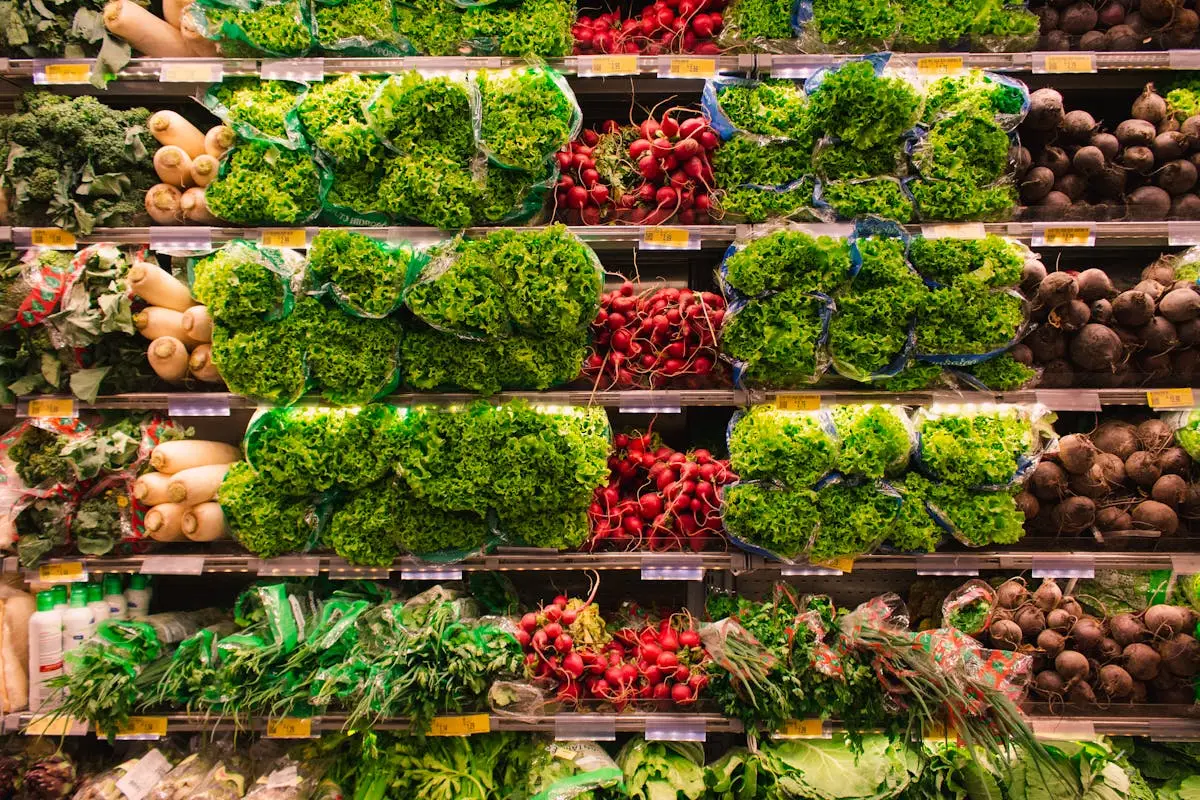
One of the first things American expats notice in Germany is that the grocery store experience works differently. The stores are smaller, the checkout is faster, and some familiar products look the same but turn out to be surprisingly different once you open the package. Other things you expected to miss are right there on the shelf — and often better than what you had back home.
Germany has the largest grocery retail market in Europe at over EUR 330 billion, with more than 22,000 supermarkets and discounters nationwide. The system is efficient, affordable, and held to some of the strictest food safety standards in the world. Here's what to expect.
Key Facts at a Glance
| Detail | Info |
|---|---|
| Grocery market size | EUR 331.9 billion (2026) |
| Largest retailer | Edeka Group (25.3% market share) |
| Leading discounters | Aldi, Lidl — together ~23% market share |
| Philadelphia cream cheese | Available — tub only, not the US brick |
| EU-banned US additives | Titanium dioxide, potassium bromate, BHA, rBST, others |
| Allergens on labels | 14 required (EU) vs 8 (US) |
| Organic (Bio) market | Mainstream — available at every store including Aldi/Lidl |
| Sunday shopping | All stores closed (Ladenschlussgesetz) |
| Bag your own groceries | Yes — bring reusable bags |
| Pfand (bottle deposit) | EUR 0.25 per can/PET, EUR 0.08–0.15 glass |
The Cream Cheese Surprise
This catches every American baker off guard. Philadelphia cream cheese exists in Germany — the familiar green packaging sits in every supermarket's dairy section. But it's only available as a soft spread in a tub. The firm 8-ounce brick that Americans use for cheesecake, frosting, and dips doesn't exist in Europe.
The difference comes down to one ingredient. American brick Philadelphia uses carob bean gum as a thickener — it's hot-soluble, meaning the cheese softens with heat but stays firm when cold. European tub Philadelphia uses guar gum instead, which is cold-soluble, so the cheese stays soft no matter how long you refrigerate it.
Both products are called Philadelphia Original, but they can't be used interchangeably. If you follow an American recipe for New York-style cheesecake using the European tub version, the result won't hold its shape.
For American-style baking, the best workaround is straining the tub version through cheesecloth overnight to remove excess moisture, or mixing it with mascarpone for more body. Some expats add cornflour to thicken it for cheesecake recipes. The European Philadelphia is essentially identical to what's sold as "cream cheese spread" in the US.
The flip side is that Germany's Frischkäse (fresh cheese) selection is enormous. A standard supermarket stocks dozens of varieties — plain, herbed, with garlic, salmon, peppers, and more. As a spread on bread, German cream cheese is genuinely excellent. Stiftung Warentest (Germany's independent consumer testing organisation) regularly tests Frischkäse products, and even budget options from discounters consistently score well.
What's Genuinely Different (and Better)
Germany doesn't just do food differently — in many categories, it does food better. The reason is structural: the EU's regulatory framework is fundamentally stricter than the US system.
Food Safety Standards
The EU operates on the precautionary principle — if a substance's safety is uncertain, it can be restricted until proven safe. The US takes the opposite approach, generally allowing ingredients unless there's evidence of harm.
The practical result: several additives common in American food are banned in the EU entirely.
- Titanium dioxide — used as a whitening agent in the US, banned in the EU since 2022 after EFSA found potential for DNA damage
- Potassium bromate — a dough strengthener in US bread, banned in the EU as a possible carcinogen
- BHA and BHT — preservatives common in US packaged food, banned or restricted in the EU for endocrine disruption concerns
- rBST/rBGH — growth hormones used in US dairy cattle, banned in the EU
- Azodicarbonamide — a bread whitener permitted in the US, banned in the EU because it breaks down into carcinogenic compounds
The EU also requires 14 allergens to be listed on food labels, compared to 8 in the US. And the EU mandates re-evaluation of previously approved additives — the US has no such process. If an ingredient was approved in 1960, there's no automatic review.
Many American expats notice their digestion improves after a few months of eating German groceries. The stricter EU regulations on additives, hormones, pesticides, and preservatives mean the baseline food quality is measurably higher — even at budget supermarkets.
Dairy, Bread, and Chocolate
Three categories where Germany clearly wins:
Dairy — milk, yoghurt, butter, Quark (a thick dairy product between yoghurt and cream cheese), and cheese are all noticeably better. No growth hormones, stricter antibiotic limits, and higher fat content standards. Quark will likely become one of your new staples.
Bread — Germany has over 3,000 registered bread varieties, recognised by UNESCO as an Intangible Cultural Heritage. Real bakeries (Bäckerei) are on virtually every corner, baking fresh daily. There is no American equivalent to the quality and variety of German bread.
Chocolate — even budget German chocolate from Aldi or Lidl is dramatically better than most American premium brands. Ritter Sport, Lindt, and Milka are everyday items here, not specialty products.
Beer
The Reinheitsgebot (German beer purity law, dating to 1516) restricts beer to four ingredients: water, hops, malt, and yeast. No high-fructose corn syrup, no artificial flavours, no rice filler. A six-pack of quality German beer costs EUR 4-6 at a supermarket.
How German Supermarkets Work
Germany's grocery retail market is structured differently from the US. There's no single mega-store where you buy food, electronics, and car batteries. Instead, different store types serve different needs.
Discounters: Aldi and Lidl
Aldi and Lidl together account for roughly 23% of the German grocery market. The stores are smaller, the selection is curated (not endless), and the prices are very low. Don't let the no-frills look fool you — the quality is genuinely good. Aldi's private-label products regularly outperform name brands in independent consumer testing by Stiftung Warentest and Öko-Test.
Most expats end up doing the majority of their shopping at discounters. Both Aldi and Lidl also carry extensive organic (Bio) product lines at prices significantly below dedicated organic stores — while meeting the same EU organic certification standards.
Full-Service Supermarkets: Edeka and Rewe
Edeka is Germany's largest food retailer with a 25.3% market share and over 10,800 stores. Rewe is the second largest, with 3,800+ stores and EUR 41.6 billion in German retail revenue (2024). Both offer wider selection, more international products, and better fresh counters (Metzgerei for meat, Käsetheke for cheese). If you're looking for specific international ingredients, Edeka and Rewe are your best bet.
Hypermarkets: Kaufland and Globus
The largest stores, closest to an American supermarket in size. Kaufland (part of the Schwarz Group, which also owns Lidl) operates 782 stores and carries a broader range of international products. Globus stores are even larger and include in-house bakeries and butchers. For one-stop shopping, these are the closest thing to what Americans are used to.
Organic Supermarkets
Dedicated organic chains — Alnatura (150+ stores), Denn's Biomarkt, and Bio Company (concentrated in Berlin) — offer premium organic products. More expensive than discounters, but the quality of produce, dairy, and bread is excellent. That said, the organic ranges at Aldi and Lidl are often nearly as good at lower prices.
German supermarket checkout is an experience. The cashier scans items at remarkable speed, and you're expected to bag everything yourself while paying. Bring your own reusable bags — plastic bags cost EUR 0.10-0.30 where they're still available, and many stores have stopped offering them entirely.
Things That Work Differently
A few practical differences that catch American newcomers off guard:
Sunday closures (Ladenschlussgesetz) — almost all retail is closed on Sundays and public holidays. This is law, not optional. Plan your shopping for Saturday at the latest. The exceptions: petrol station shops, train station stores, and some bakeries open Sunday mornings.
The Pfand system — Germany's bottle deposit system charges EUR 0.25 for single-use PET bottles and cans, and EUR 0.08-0.15 for reusable glass bottles. Return machines (Pfandautomaten) are in every supermarket. The system achieves return rates above 95%.
Eggs aren't refrigerated — German supermarkets store eggs at room temperature, which surprises Americans. In the EU, eggs aren't washed before sale (which preserves their natural protective coating), so refrigeration isn't necessary. The US washes eggs, which removes that coating and requires cold storage.
Smaller quantities — German packaging tends to be smaller than American equivalents. Milk comes in 1-litre cartons (about a quarter of a US gallon). You won't find gallon jugs of milk or 48-pack toilet paper rolls at a standard supermarket.
Cash is still common — while card acceptance has improved significantly since the pandemic, many smaller shops and bakeries still prefer cash. Always carry some euros.
Where to Find International Products
For specific American products or international ingredients, these are your options:
- Edeka and Rewe — the widest international selections among standard supermarkets, including American brands in larger stores
- Kaufland — hypermarket chain with dedicated international food sections
- Asian supermarkets — excellent for rice varieties, sauces, spices, and ingredients you won't find at German stores
- Turkish supermarkets — great for spices, flatbreads, fresh herbs, and affordable produce
- Online import shops — American Heritage (americanheritage.de) and similar retailers deliver American branded products across Germany, though at import-level prices
- Amazon.de — carries many American branded items, though typically at a premium
Frequently Asked Questions
Is food expensive in Germany compared to the US?
Groceries in Germany are generally cheaper than in the US, especially at discounters. Aldi and Lidl offer high-quality food at prices that consistently undercut American supermarkets. A single person can eat well for EUR 200-300/month. The German Retail Federation (HDE) tracks consumer spending closely, and Germany remains one of the most affordable food markets in Western Europe.
Are organic products widely available?
Yes — Germany is the largest organic food market in Europe. Bio products are mainstream, available at every supermarket including Aldi and Lidl. Both discounters carry extensive certified organic ranges at significantly lower prices than dedicated organic stores. EU organic certification standards are uniform, so a Bio label at Aldi meets the same requirements as one at Alnatura.
What about dietary requirements (vegan, gluten-free)?
Germany has excellent options for both. Vegan products are mainstream — Germany has one of the largest vegan populations in Europe, and even discounters stock extensive plant-based ranges. Gluten-free (glutenfrei) sections are standard in most supermarkets. Labelling is thorough, with 14 allergens required on EU food labels.
Do I need to bring my own bags?
Yes. Single-use plastic bags have been largely phased out, and where still available they cost EUR 0.10-0.30. Bring reusable bags or a backpack. Most Germans keep sturdy reusable bags ready for shopping trips.
How do food safety standards compare to the US?
The EU's precautionary principle means stricter baseline standards. Several additives and hormones permitted in the US are banned in the EU. Growth hormones in beef, many synthetic food colourings, and certain preservatives are not allowed. The EU also requires regular re-evaluation of approved substances — something the US FDA does not mandate. In February 2026, the FDA launched new safety reviews of BHA, following the EU's lead.
Adjusting to German grocery shopping takes a week or two, not months. The stores are efficient, the food is good, and the prices are fair. The things that are different — Sunday closures, the Pfand system, lightning-fast checkout — become second nature quickly. And most expats find that once they've settled in, they actually eat better than they did back home. Stricter standards, fresher bread, better dairy, and chocolate that doesn't need to be a "premium" brand to taste good.
At Move2Europe, we help professionals navigate the full relocation process — from visa applications to settling into daily life.
Book a free consultation and let's figure out your path to Germany.
Official sources:
- bmel.de — Federal Ministry of Food and Agriculture (BMEL)
- bvl.bund.de — Federal Office of Consumer Protection and Food Safety
- efsa.europa.eu — European Food Safety Authority (EFSA)
- test.de — Stiftung Warentest (independent consumer testing)
- ecommercegermany.com — German grocery retail market data
- fda.gov — US Food and Drug Administration (for comparison)